Learning to surf after 40 is highly realistic, particularly at a surf camp Bali where warm water and soft waves assist with mobility and recovery. Professional surf lessons Canggu prioritize coordination over raw power, making a surf and yoga retreat Bali the ideal environment for mature beginners to gain confidence safely. As the best surf camp Bali for those seeking a balanced lifestyle, Kavo Maison offers a supportive surf retreat Bali experience that proves age is no barrier to catching your first wave. Read our full guide to surfing later in life below.
Can you realistically learn to surf after 40?
Yes, and many people actually enjoy learning more when they start later in life.
The idea that surfing is only for teenagers or twenty-year-olds is mostly an image problem. Social media shows big waves, athletic bodies and extreme energy. Beginner surfing looks very different.
Learning to surf after 40 is not only possible it’s often calmer, more intentional and surprisingly rewarding.

Is surfing over 40 physically harder?
It can feel different, but not necessarily harder.
What changes is not your ability to learn, it’s your recovery time and flexibility. Surfing requires:
- Basic mobility
- Core stability
- Balance
- Comfortable paddling
- Controlled pop-up movement
You don’t need explosive power. You need coordination and consistency.
In fact, many people over 40 approach surf lessons more carefully, which reduces mistakes and speeds up steady progress.
Does age slow down progress?
Not dramatically, mindset matters more than age.
Here’s what we typically observe with beginners learning to surf at 40 or 50:
| Factor | Under 30 | 40+ Beginners |
| Risk-taking | Higher | Lower |
| Listening to instruction | Mixed | Strong |
| Physical recovery | Faster | Slightly slower |
| Emotional patience | Variable | Higher |
| Long-term consistency | Mixed | Often stronger |
Older beginners may take an extra session to feel fully confident, but once they do, progress becomes stable.

Is it more dangerous to start surfing later in life?
No, beginner surfing in controlled conditions is low risk at any age.
Most common issues are:
- Muscle soreness
- Mild fatigue
- Small board bumps
Serious injuries are rare when learning properly at a structured surf camp.
Risk increases only when:
- People surf beyond their level
- Conditions are too heavy
- There’s no professional guidance
Choosing the right environment matters far more than age.
Why Bali is often ideal for learning after 40
Bali removes many physical barriers that make learning harder elsewhere.
Compared to Portugal, Morocco or parts of Australia, Bali offers:
- Warm water year-round (no heavy wetsuits)
- Softer rolling waves in beginner zones
- Consistent daily surf conditions
- Less cold-related muscle tension
- Predictable learning environments
Warm water alone makes a significant difference for joints and recovery.
That’s why many travelers specifically search for a surf camp Bali when considering learning later in life.

Will I feel out of place at a surf camp if I’m not in my 20s?
No, many balanced camps have a wide age range.
Not every surf camp Bali is party-oriented. The more lifestyle-focused camps near Canggu often host:
- Travelers in their 30s
- Couples in their 40s
- Solo travelers in their 50s
- Remote professionals on long-term stays
The atmosphere is usually more important than the average age.
If you choose the best surf camp Bali for your personality — not the loudest one — you won’t feel out of place.

Is learning to surf after 40 mentally harder?
Sometimes — because you’re more aware of risk.
At 20, you jump without thinking.
At 45, you calculate.
That awareness can slow the first session slightly. But once trust builds — in the instructor, the ocean and your body — confidence rises quickly.
Older beginners often describe the experience as:
- Grounding
- Empowering
- Unexpectedly emotional
- Deeply satisfying
Because it represents stepping outside comfort zones again.
How long does it take to learn to surf after 40?
A realistic beginner timeline:
- Session 1–2: First successful stand-up
- Session 3–4: More consistent balance
- Day 5–7: Clear confidence and wave timing
Age doesn’t double the timeline. It may just slightly shift the beginning.
Consistency matters more than youth.

Is surfing after 40 actually more meaningful?
For many people, yes.
At this stage of life, learning something completely new feels different. It’s less about proving something and more about experiencing something.
Catching your first wave at 45 often feels bigger than catching it at 19 — because it challenges the internal story of “I’m too old for this.”
And that shift carries into other areas of life.
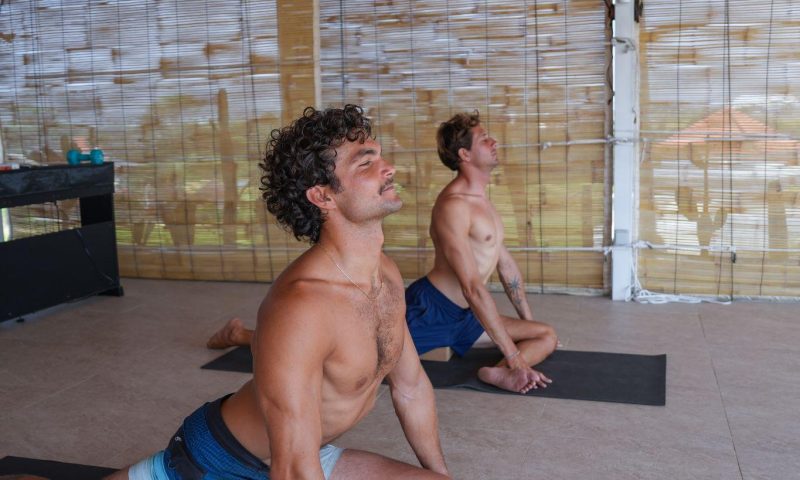
To balance the physical challenge, many guests find that a surf and yoga retreat is the perfect way to recover. Yoga helps with the flexibility and mobility needed for surfing, making the whole experience feel like a wellness journey rather than just a sport.
Who should consider learning to surf after 40?
You’re a good candidate if you:
- Stay moderately active
- Are open to learning
- Don’t expect instant perfection
- Value experience over ego
- Want to try something outside your routine
You don’t need to be an athlete. You need curiosity.
Final Thought
You’re rarely “too old” to learn to surf.
You’re usually just outside your comfort zone.
With warm water, beginner-friendly waves and a balanced atmosphere, learning later in life can feel calmer, more intentional and even more rewarding. If you’re considering starting in supportive tropical conditions, you can always explore our surf camp Bali.