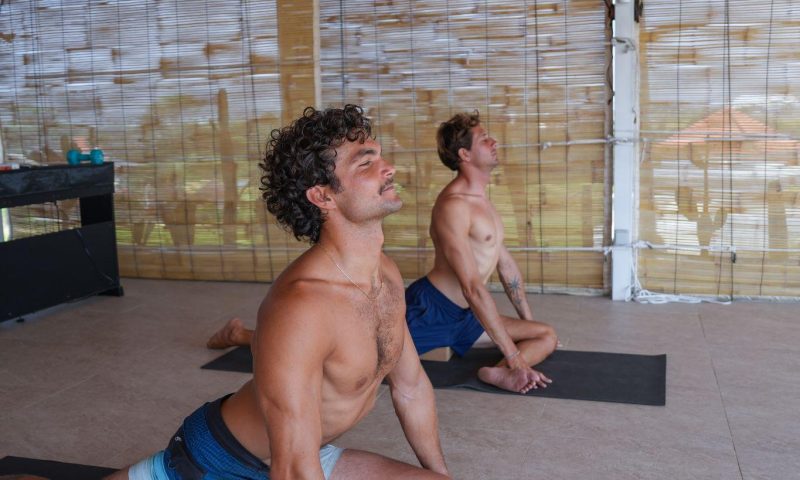
Although yoga and surfing may not seem to have much in common, they are actually very similar. In yoga, as in surfing, you need a lot of balance, strength and mental focus. These are the three keys that make these two sports very similar, but there is another one that, in my opinion, unites them: the connection with nature. In fact, in both surfing and yoga, one of the basics is to be connected with the surrounding environment. Whether it is the ocean, a meadow, a beach… the connection with the here and now is essential. And I’ll tell you more, there is another thing that yoga and surfing have in common, the fact that you can practise them almost anywhere, with only the need for a base, in surfing a board, in yoga a mat.
In short, there are so many connections that more and more surfers have decided to integrate yoga into their daily routine. There is a growing awareness of how regular yoga practice can help prevent injuries and strains while surfing and improve performance in the water thanks to the movements learned on the mat. This is why a surf and yoga retreat Bali is becoming so popular.
1. Why surfers need yoga
To summarise what has already been said above, here is a complete list of reasons why surfers should introduce yoga into their daily routine:
- More balance on the surfboard
- More muscle elasticity
- Faster muscle recovery
- Greater connection between body and mind
- Calmer and more controlled breathing
- Relaxed nerves and muscles even in the most intense situations in the water
- Pre- and post-surf relaxation thanks to different yoga positions
Now that this list has made it clear how essential yoga is for being a good surfer, let’s get into the best asanas (yoga positions) for surfers.
2. Pose 1: Warrior II (Virabhadrasana II)

This position mainly improves stability and strength in the legs, essential qualities for take-off on a surfboard in the water. In the Warrior II position, the front leg is bent at 90 degrees with the foot pointing forwards, and the back leg is stretched out with the foot pointing outwards, while the back remains straight. This position is very similar to the position you adopt on a surfboard.
There are several variations of this position, which can also help improve balance. You can decide to bring your back hand closer to your back ankle, which will stretch your back and force your core to work to maintain balance. Conversely, you can bring your front arm closer to your front foot, raising the opposite arm towards the sky. This will also stretch the upper body more and train your stability.
3. Pose 2: Tree pose (Vrksasana)

The tree pose is apparently very simple, but doing it correctly can take a lot of effort. Standing with your hands clasped in front of your chest, place the base of one foot on the inside of the opposite thigh. You will find yourself balancing on one leg. At this point, you can decide to raise your arms, keeping your hands clasped, towards the sky. That’s it, you are now in the tree pose.
This pose helps with mental concentration, encouraging us to connect with our breathing and stay focused on the here and now. All of this is very useful when you find yourself on a surfboard riding a wave. A little tip for beginners: hold on to the wall for greater stability. If you’re staying at a surf camp Bali, this is a great pose to practice every morning to get centered.
4. Pose 3: Downward dog (Adho mukha svanasana)

And here it is, how could it be missing? The most famous, most cited, most discussed pose in yoga: the downward dog. As trivial as this pose may seem, it is not. Try to hold the pose for several minutes, focus on your breathing, and bring your attention to where you feel tension. Remember, the main focus should be on your back, which should be straight and not curved. Keep your shoulders away from your ears and your neck relaxed. Let your legs bend if necessary, and try to rest your heels on the ground. Now, the simple downward dog position may not seem so simple anymore.
This asana will give you a full-body stretch and help strengthen your shoulders and core. It is also an excellent pose for “resting” and taking a break between other asanas.
5. Pose 4: Cobra Pose (Bhujangasana)

And why not introduce an asana that can help open up the chest and strengthen the back? The cobra pose helps to keep the chest open, increase flexibility between the shoulders and neck, and, last but not least, strengthen the back muscles. You can decide to stop at the cobra pose, or push yourself further and stretch into the upward-facing dog pose. Whichever pose you choose, your body will thank you.
Needless to say, this pose is extremely helpful in improving your paddling position on the surfboard. Strengthening your back muscles and working on opening your chest will be the key to paddling in the water with less effort. Not only that, it will also help your posture out of the water.
6. Pose 5: Seated Twist (Ardha Matsyendrasana)

And finally, an asana that improves spinal movement, making it easier for you to change position. To practise this pose, simply sit cross-legged on the mat and rotate your head, shoulders, chest and back 180 degrees, looking behind you. To ensure that this pose is beneficial to the body, hold it for a long time and focus on your breathing. As you inhale, stretch upwards and as you exhale, rotate further and further.
This pose not only helps before surfing by improving spinal mobility, but can also be very useful after training. It is an excellent stretch not only for the back, but for the entire upper body. You will often find this specific stretch taught at the best surf camp Bali to help with post-surf recovery.
Tips for integrating yoga into a surf lifestyle
If all this has convinced you and you feel ready to integrate yoga into your daily routine, I recommend starting by dedicating 15-20 minutes a day to these exercises. Whether you do it before surfing, as soon as you wake up in the morning, or after surfing, before going to sleep, the important thing is to practise yoga with mindfulness. If you’re looking for a more immersive experience, consider joining a surf and yoga retreat Bali to combine both passions. Don’t forget to focus on your breathing too. Try to force your brain to stay focused on your nasal breathing. You will see that it will help you not only with muscle stretching but also with mental relaxation.
And even more importantly: in yoga, it is not the intensity of the practice that matters, but consistency. Practise every day for a few minutes, and in no time at all, you will notice many benefits.
FAQ: Yoga for surfers
- Do I need to be flexible to start yoga?
No, yoga builds flexibility over time. - Should I practice before or after surfing?
Entrambi: prima per attivare il corpo, dopo per recuperare. - How often should surfers practice yoga?
Almeno 2–3 volte a settimana per risultati visibili. - Can beginners try these poses safely?
Yes, start slowly and use modifications if needed.