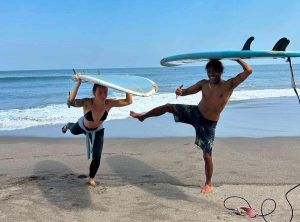
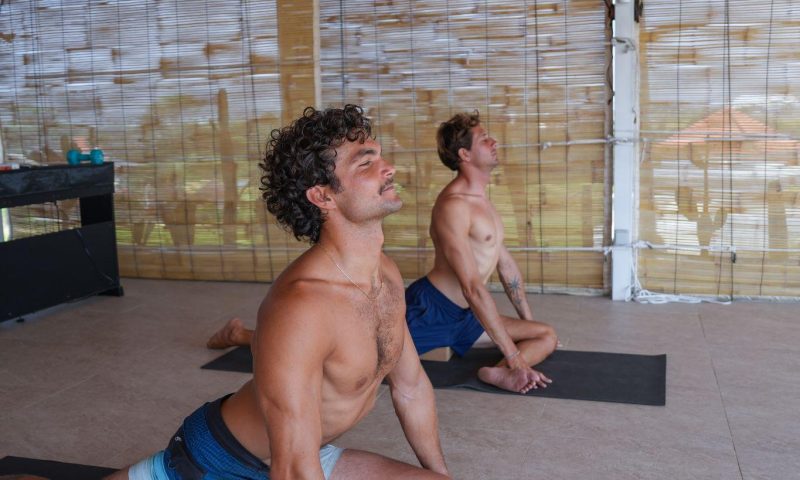
Beginner surfers most often struggle with a few predictable mistakes: standing up before the wave pushes the board, looking down at their feet, and using the wrong equipment. Whether you are taking individual surf lessons Canggu or joining a full beginner surf camp Bali, overcoming these hurdles is simply part of the learning curve. By understanding how to fix your timing, focus your gaze, and rely on expert real-time coaching from a dedicated retreat like Kavo Maison, you can bypass weeks of frustration. Read on to discover how our beginner-friendly surf and yoga packages help you correct these mistakes faster, or browse our packages below to start your surf journey.
Every surfer has made beginner mistakes. Anyone who claims otherwise either has a terrible memory or is trying very hard to look cool.
The first few surf sessions are rarely graceful. You paddle at the wrong moment, stand up when the board is barely moving, look directly at your feet and then wonder why you fell. None of this means you are bad at surfing. It simply means your body is learning something completely unfamiliar.
That awkward stage is part of the experience, whether you take individual surf lessons Canggu or spend a full week at a surf camp Bali.

Why do beginners stand up too early?
Beginners stand up too early because they confuse the first movement of the board with the actual push of the wave.
You feel the board wobble, your brain thinks, “This is it,” and suddenly you are trying to stand on something that is not really moving yet. Gravity normally handles the rest.
The fix is not to move faster. It is actually the opposite.
Wait for the moment when the wave properly lifts and pushes the board forward. That extra half second feels strange at first, especially when you are excited, but it often makes the difference between immediately falling and getting your first proper ride.
This is one of those mistakes that is hard to understand from the beach. Once you feel the difference in the water, it starts making sense very quickly.
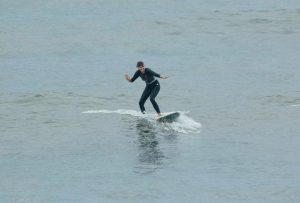
Why does looking down make you fall?
Looking down makes you fall because your body naturally follows the direction of your eyes.
Almost every beginner stares at the board, their feet or the water directly in front of them. It feels logical. You want to check whether your feet are in the correct place.
Unfortunately, the moment your head drops, your shoulders usually follow. Then your weight moves forward, your balance disappears and the wave continues without you.
A simple instruction often fixes it:
Look towards the beach, not towards your feet.
It sounds almost too basic, but it works. During beginner surf lessons Canggu, coaches repeat this constantly because the correction can change someone’s position immediately.
Your feet do not need to be perfect. Your direction matters more.
Why does paddling feel so exhausting?
Paddling feels exhausting when the technique is wrong, not necessarily because you are unfit.
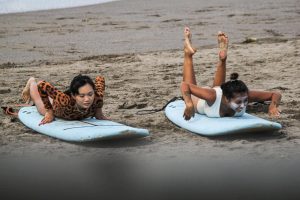
This mistake is sneakier than falling during the pop up. Beginners often assume they simply need stronger arms. In reality, they may be using flat hands, taking short strokes or lying too far forward on the board.
When your chest is too low, the nose of the board starts digging into the water. Instead of gliding, you are pushing water in front of you. No wonder it feels exhausting.
Better paddling usually means:
* Reaching further forward
* Keeping the fingers together rather than spreading them wide
* Pulling the water back with a complete stroke
* Finding the correct position on the board
Good paddling is mainly about efficiency. That is genuinely good news, because technique can improve much faster than fitness.
Why is choosing the right surfboard so important?
The right surfboard gives beginners stability, flotation and enough time to complete the movement.
Shortboards look great in photos. They are light, fast and closely connected to the image many people have of surfing. They are also extremely frustrating for most complete beginners.
A beginner usually needs volume. That means a board that is longer, wider and thicker, with enough flotation to remain stable while paddling and standing up.
It may not look as impressive under your arm, but it will help you catch more waves. More waves mean more attempts, and more attempts mean faster progress.
This is why a proper surf camp Bali will choose the board according to your height, weight and experience, rather than simply handing everyone the same equipment.
It is not a question of style. It is physics.

Why do beginners expect progress to happen in a straight line?
Beginners expect steady progress because most activities are presented as a simple sequence, practice more, improve more.
Surfing does not always work like that.
You may stand beautifully on your second wave, then fall on the next twenty. The following day may feel easier, or you may suddenly feel like you have forgotten everything.
Conditions change. Your arms get tired. The tide moves. The wind changes direction. Muscles you did not know existed begin complaining after the first few sessions.
Progress in surfing normally comes in jumps.
One session feels confusing, then something clicks. The next morning feels difficult again, then another small improvement appears. It is rarely smooth, and that is completely normal.
At a surf retreat Bali, repeated sessions help because you do not have to restart from zero each time. Your body gradually remembers the movement, even when your mind thinks nothing is improving.
Is fear of looking bad a common beginner mistake?
Yes, worrying about looking bad often makes beginners more tense than the waves themselves.
People imagine everyone on the beach is watching them fall. In reality, most people are focused on their own session, their own board or their own problems.
Falling is not the embarrassing part of learning to surf. Falling is the learning process.
The sooner you stop trying to look good, the easier everything becomes. Your body relaxes, your movement becomes less rushed and you are more willing to try again.
This is also one reason a beginner surf camp Bali experience can feel easier than learning alone. You are surrounded by people who are making the same mistakes, laughing at the same falls and celebrating very small victories together.
Why does professional coaching make such a difference?
Professional coaching matters because you cannot always feel your own mistakes from inside the movement.
You may genuinely believe you are looking forward when your eyes are still fixed on the board. You may think you are centred when your weight is too far back. You may feel like you are paddling strongly while barely moving.
A coach sees what you cannot see.
Sometimes one sentence solves a problem that could have taken several sessions to understand alone. Coaching does not remove the learning curve, and it does not magically turn anyone into a surfer in one day. It simply helps make sure you are not practising the wrong movement for an entire week.
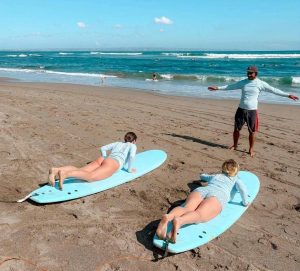
At Kavo Maison Surf & Yoga Camp, sessions are adapted to each guest’s level, so complete beginners are not expected to follow the same pace as more experienced surfers.
What should beginners focus on during their first week?
Beginners should focus on repetition, safety and small improvements rather than trying to look like experienced surfers.
A realistic first week may look something like this:
| Stage | What usually improves |
|---|---|
| First session | Comfort with the board, basic safety, first attempts |
| Second and third sessions | Better timing, paddling and pop up position |
| Middle of the week | More successful rides, less tension |
| End of the week | Better confidence and understanding of the waves |
Are beginner mistakes a sign that surfing is not for you?
No, beginner mistakes are a sign that you are actually learning.
Standing too early, looking down, choosing the wrong board and feeling tired are not proof that you lack talent. They are simply the same problems almost every new surfer has to work through.
The first week is not about becoming perfect. It is about learning how the ocean feels, how your board responds and how your body reacts.
Once those pieces begin connecting, surfing becomes far less mysterious.
FAQ
Can complete beginners join a surf camp in Bali?
Yes, most surf camps in Bali are designed to welcome complete beginners, including people who have never touched a surfboard before.
How many surf lessons does a beginner need?
Most beginners notice a clear difference after three to five consistent sessions, although the exact timeline depends on confidence, conditions and individual coordination.
Are surf lessons in Canggu suitable for beginners?
Yes, Canggu and the surrounding coastline offer several beginner-friendly conditions, but the location and timing should always be chosen according to the day’s waves and tides.
Do I need to bring my own surfboard?
No, beginner-friendly boards are normally provided during lessons and selected according to your size and current ability.
Is a surf and yoga retreat in Bali useful for recovery?
Yes, yoga and mobility sessions can help release tension, support flexibility and make the body feel better between consecutive surf days.
Final Thought
The mistakes you make during your first surf sessions are not something to avoid at all costs. They are the beginning of understanding what surfing actually requires.
You will stand too early. You will look down. You will probably fall in a way that makes no sense at all. Then, slowly, the movements begin to feel less foreign.
That is usually when the fun really starts.
To experience beginner-friendly coaching, daily progression and the social side of learning together, discover more about Kavo Maison Surf & Yoga Camp near Canggu.