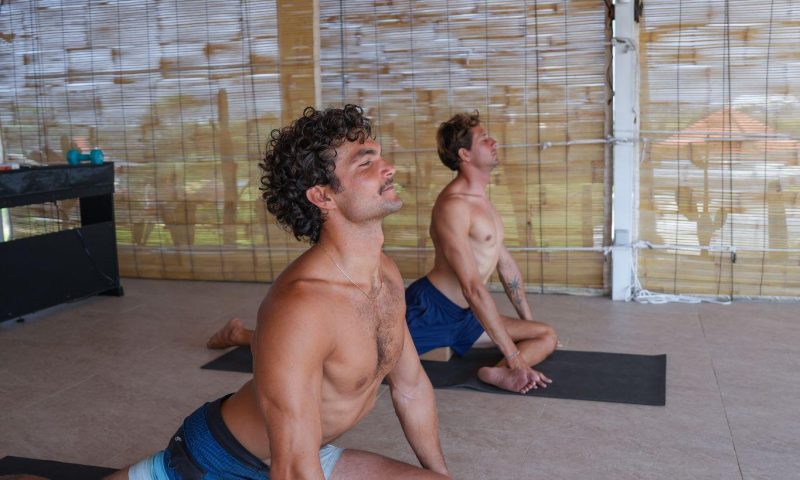
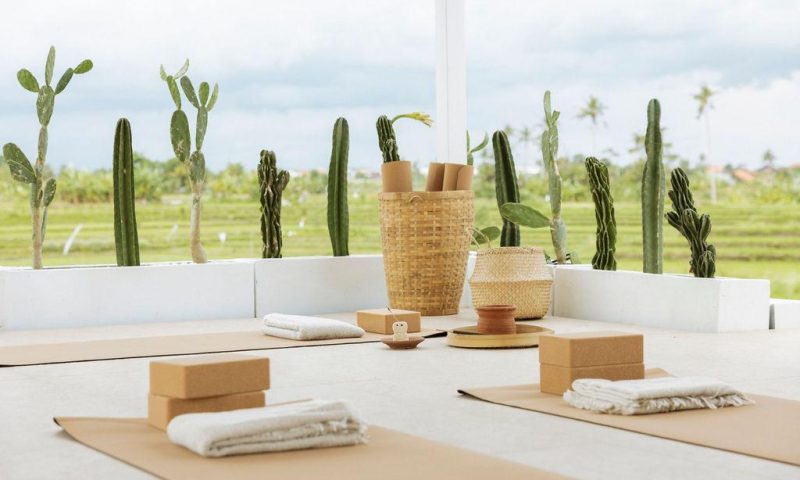
A wellness retreat differs from a regular holiday because it replaces constant decision-making and packed sightseeing with light structure, built-in rest and a slower pace. A traditional trip often leaves travellers tired from planning, navigating and moving between places, while a wellness retreat in Bali offers a steady rhythm of daily movement, wholesome meals and free time. A surf and yoga retreat Bali, like the one at Kavo Maison, pairs energetic mornings in the ocean with yoga to slow things down again. Set among the rice fields roughly ten minutes from both Canggu and Kedungu, it helps reduce decision fatigue, makes it easier to meet other guests, and leaves space to relax, explore or simply stay put.
Keep reading to find out how a retreat changes your pace, what a typical day looks like, and which area of Bali suits a wellness trip best.
On paper, they look fairly similar.
You book a flight. Pack a bag. Set your out-of-office. Leave home for a while.
Maybe there’s a pool involved.
That’s roughly where the similarities end.
Because we’ve all come home from a holiday feeling like we need another holiday.
Ten days of changing hotels, waking up early for tours, finding restaurants, checking maps, catching boats, trying not to miss anything and somehow spending more time organising the trip than actually being on it.
It can be brilliant.
It can also be exhausting.
A wellness retreat in Bali starts from a slightly different idea. You’re still travelling and experiencing somewhere new, but seeing as much as possible isn’t necessarily the goal.
Sometimes the goal is simply to stop feeling like you’re running behind.
And that changes the whole rhythm of the trip.
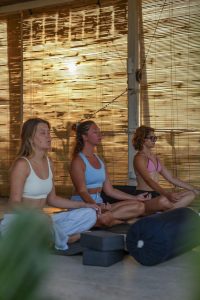
A holiday changes your location. A retreat changes your pace.
This is probably the biggest difference between the two.
A regular holiday can easily become your normal life with a better view.
You wake up, grab your phone, check where you’re going, work out transport, make a reservation, rush somewhere because you’re late, take photos, realise there’s another place you wanted to see before sunset.
It’s fun.
But you’re still rushing.
A retreat deliberately creates fewer decisions.
You wake up knowing roughly how the morning will unfold. Maybe there’s yoga. Maybe you’re surfing. Breakfast happens around the same rhythm each day. There are activities you can join and enough empty space around them that the day can breathe a little.
That structure might sound restrictive before you’ve experienced it.
In reality, it can be incredibly freeing.
For once, you don’t have to figure everything out.
You don’t have to optimise every day
There’s a strange pressure attached to travelling somewhere like Bali.
You’ve come all this way, so obviously you should make the most of it.
Which apparently means doing absolutely everything.
Ubud.
Uluwatu.
Canggu.
Kedungu.
Nusa Penida.
Waterfall.
Temple.
Sunrise hike.
Beach club.
Massage.
Surf lesson.
Yoga.
Somehow all before Thursday.
A retreat gives you permission to stop treating your holiday like a project that needs optimising.
You might still explore. In fact, you probably should.
But you have a base to come back to instead of constantly packing your bag and moving to the next place.
Staying in one area for several days also means you start noticing things you completely miss when you’re passing through.
The same person placing offerings outside each morning. The little warung you walked past on day one. How different the rice fields look just before sunset.
You stop consuming Bali quite so quickly.
You start living in it a little.

Structure can actually feel like freedom
This sounds backwards until you’ve spent a few days at a retreat.
When you’re on a normal holiday, almost every day begins with decisions.
Where are we having breakfast?
What are we doing?
How do we get there?
Should we book something?
What’s the weather doing?
Where should we eat tonight?
None of these are particularly difficult decisions.
There are just a lot of them.
At a yoga retreat in Bali, some of that disappears. There’s a loose rhythm already waiting for you.
You know there’s movement in the morning. You know where breakfast is. You know you don’t need to research twenty yoga studios or organise every detail yourself.
The structure takes care of the boring bits.
What you do with the space around it is still yours.
That’s an important distinction because a retreat shouldn’t feel like summer camp for adults.
Nobody wants to hear a whistle at 6:45 telling them it’s time for mandatory personal growth.
Rest is actually part of the plan
On a normal holiday, rest sometimes feels like something that happens when the plan fails.
It rains, so you stay in.
You’re tired, so you cancel dinner.
You accidentally sleep until eleven and feel slightly guilty about losing the morning.
At a wellness retreat, rest isn’t the thing you squeeze between activities.
It’s part of why you’re there.
Maybe you spend an afternoon by the pool.
Maybe you get a massage.
Maybe you finish breakfast and stay at the table for another hour because the conversation is good.
Maybe you do absolutely nothing for a while.
None of that means you’re wasting your trip.
If you arrived in Bali already exhausted, filling every free hour with another “wellness activity” rather defeats the point.
Sometimes the most useful thing on the programme is the blank space.

Movement feels different when it isn’t punishment
A lot of us have a slightly complicated relationship with exercise at home.
You should work out.
You should go to the gym.
You should close the rings on your watch.
Movement becomes another task.
On a retreat, it can feel different.
You surf because being in the ocean is fun.
You practise yoga because your shoulders are asking for it after paddling.
You walk somewhere because you want to see what’s around the corner.
There’s still effort involved. Anyone who has tried their first surf lesson knows that.
But the motivation changes.
This is one reason a surf and yoga retreat Bali works so naturally as a combination.
Surfing is energetic, messy and unpredictable. Yoga slows things down again.
One morning you might feel strong.
The next, you fall off your board fifteen times and discover that your arms are apparently no longer interested in cooperating.
Then you stretch, eat something and try again tomorrow.
That’s enough.
Surfing forces you to be present without asking you to be mindful
There’s a lot of talk around mindfulness at wellness retreats.
Sometimes it can feel a little abstract.
Surfing makes the concept much easier.
When a wave is coming towards you, you’re not thinking about the email you forgot to answer.
You’re thinking about the wave.
That’s it.
You paddle. Look around. Listen to your instructor. Try to get your feet underneath you.
Then you fall into the water.
For a few seconds, the rest of your life genuinely disappears.
You can’t hurry the ocean either.
You can have a plan for your surf session, but tide, wind and swell don’t care very much about your itinerary.
For people used to controlling every part of their schedule, that’s surprisingly refreshing.
It’s also one reason staying at a surf camp Bali can feel very different from simply adding one surf lesson to a busy holiday.
You get into the rhythm rather than ticking surfing off the list.

A wellness retreat doesn’t need to be serious all the time
This matters.
“Wellness retreat” can sound like you’re about to spend seven days whispering, drinking green juice and discussing your feelings before breakfast.
Some retreats are probably like that.
They don’t all need to be.
Wellness can also be laughing over breakfast.
Going surfing and being spectacularly bad at it.
Eating good food.
Meeting somebody you’d never have crossed paths with at home.
Going out for dinner.
Having a beer if you want one.
Sleeping for nine hours.
A retreat doesn’t need to remove fun from the holiday in order to make it good for you.
The sweet spot is usually somewhere between having enough structure to feel supported and enough freedom to still feel like you’re on holiday.
Community changes the experience more than people expect
This is particularly noticeable for solo travellers.
On a normal holiday, you can spend an entire week surrounded by people without actually meeting anyone.
You stay in a hotel. Eat at a restaurant. Take a tour. Go back to your room.
At a smaller wellness retreat in Bali, you keep seeing the same faces.
At yoga.
At breakfast.
In the surf van.
By the pool.
Somebody asks what you’re doing later. Someone else wants to go for dinner. By day three, the group chat exists.
Nobody scheduled the friendship workshop.
It just happened.
For many guests, this ends up being one of the parts they talk about most afterwards.
They booked because of yoga or surfing.
They remember the people.

Mindful travel is usually much less glamorous than Instagram makes it look
Mindful travel doesn’t require sitting cross-legged in front of a rice field at sunrise.
You can, obviously.
It makes a lovely photo.
But in everyday terms, it’s much smaller.
Eating breakfast without scrolling.
Actually looking at the ocean after surfing instead of immediately checking your phone.
Noticing the offerings you’ve walked past every morning.
Talking to local people instead of only moving between businesses designed for tourists.
Letting dinner take longer.
Going somewhere without needing to turn it into content.
Those things don’t sound particularly revolutionary.
Do them repeatedly for a week and you might notice how rarely you do them at home.
Where you stay in Bali matters more than you think
Location changes the retreat experience quite a lot.
Stay somewhere extremely isolated and you might love the silence, but feel cut off if you want to explore.
Stay directly in the busiest part of Canggu and you have hundreds of restaurants and cafés nearby, but switching off can be considerably harder.
For us, being between Canggu and Kedungu creates an interesting middle ground.
Canggu is roughly ten minutes away when you want its cafés, restaurants, shops and social scene.
Head in the other direction and you’re around ten minutes from Kedungu, an area that’s becoming increasingly interesting for surfing and for travellers wanting to see another side of Bali’s west coast.
Then you come back to the rice fields.
That’s where Kavo Maison sits.
Close enough that you don’t feel isolated.
Far enough that mornings still feel like mornings.
Is Kedungu a good area for wellness travellers?
Kedungu is becoming an interesting alternative for people who like Bali’s west coast but don’t necessarily want to spend all their time in central Canggu.
The area is attracting more attention, particularly around Kedungu surf, cafés and the slower lifestyle surrounding this part of the coast.
It’s changing, of course. Bali always is.
But for now, exploring between Canggu and Kedungu gives you two quite different experiences within a relatively small area.
One day can involve brunch and shopping in Canggu.
Another might be surfing or exploring towards Kedungu.
And another might involve going nowhere at all.
For a wellness trip, having those options without constantly changing accommodation is useful.
A retreat can make decision fatigue disappear for a while
This might be one of the least sexy benefits of a retreat.
Nobody puts “make fewer decisions” on their Bali bucket list.
But it feels fantastic.
At home, you’re constantly choosing.
What to cook. When to exercise. Which email matters. What needs doing first. Where to go. What to buy. What to answer.
Then you go on holiday and add another layer of choices.
A retreat takes some of those away.
Breakfast is there.
There’s a yoga space.
The surf session is organised.
Someone who understands the local conditions decides where it makes sense to surf.
You still have choices.
You just don’t have to make all of them.
Your brain gets to be slightly less useful for a week.

Will you actually feel different after a wellness retreat?
Maybe.
But we’d be suspicious of anyone promising to transform your life in seven days.
A wellness retreat in Bali isn’t therapy, magic or a shortcut to becoming a completely different person.
You’re still going home to your actual life afterwards.
What can change is how you feel while you’re here.
Maybe you sleep better.
Maybe you realise how tired you were.
Maybe you rediscover how much you like moving when exercise isn’t something you have to do.
Maybe you spend less time on your phone.
Maybe nothing profound happens at all and you simply feel rested.
That’s a pretty good outcome too.
So, wellness retreat or regular holiday?
It depends entirely on what you need from the trip.
If you’ve been waiting all year to explore Bali and have a list of places you’re genuinely excited to see, go explore them.
A regular holiday can be wonderful.
If you’re already tired before you’ve even packed your suitcase, though, perhaps don’t build another exhausting schedule on the other side of the world.
That’s where a retreat starts making sense.
Not because you need to “fix” yourself.
You might simply need a few days where breakfast is already sorted, somebody else is thinking about tomorrow’s surf conditions and there’s absolutely nothing wrong with spending an afternoon by the pool.
That’s the thinking behind the Wellness & Yoga experience at Kavo Maison.
We’re based among the rice fields, roughly halfway between Canggu and Kedungu, with both areas around ten minutes away. The experience combines yoga, movement, wellness, Balinese massages, community and enough free time to explore or simply stay put.
Because coming home rested shouldn’t be the surprising part of a holiday.
FAQ
What is the difference between a wellness retreat and a normal holiday?
A normal holiday is usually self-directed, while a wellness retreat provides some structure around activities, meals, movement and rest. The main difference isn’t necessarily what you do, but the pace of the experience and how much planning you need to manage yourself.
What happens at a wellness retreat in Bali?
Every retreat is different. A wellness retreat in Bali may include yoga, meditation, breathwork, massage, healthy meals, cultural experiences and free time. Some retreats also combine wellness with activities such as surfing.
Do I need to be experienced at yoga to join a yoga retreat in Bali?
Usually not. Many yoga retreats in Bali welcome beginners, but you should always check the specific programme before booking. At Kavo Maison
, the focus is on making movement part of the experience rather than expecting everyone to arrive with an advanced yoga practice.
What is the difference between a surf camp and a surf and yoga retreat?
A traditional surf camp Bali tends to place surfing at the centre of the programme. A surf and yoga retreat Bali combines time in the ocean with yoga, recovery and a broader wellness experience. The exact balance depends on the retreat.
Is Canggu or Kedungu better for a wellness trip?
They offer different atmospheres. Canggu has a large choice of restaurants, cafés, gyms and wellness businesses, while Kedungu currently has a quieter feel and a growing surf and lifestyle scene. Staying between Canggu and Kedungu makes it possible to explore both.
Can I join a wellness retreat in Bali as a solo traveller?
Yes. Retreats can be particularly suitable for solo travellers because shared meals and activities make meeting other guests much easier than at a conventional hotel. You still have free time, but there’s already a community around you.
How long should I stay at a wellness retreat?
There isn’t one perfect length, but several consecutive days give you more time to settle into the routine. A week allows you to experience the activities while still leaving room for rest and free time, rather than trying to fit everything into a weekend.
Will a wellness retreat actually help me relax?
It can create better conditions for rest by reducing planning, keeping you in one place for longer and building downtime into the experience. How you feel afterwards will always be individual, and a retreat shouldn’t promise a complete physical or emotional transformation.