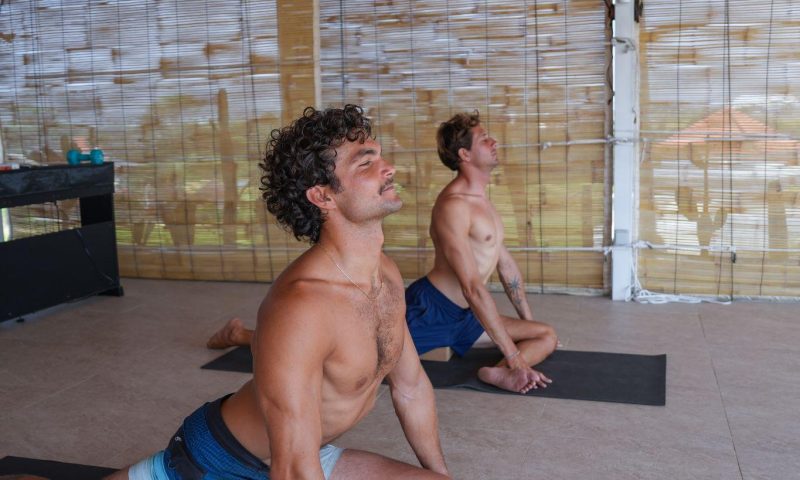
Individual surf lessons or a surf camp in Bali — which should you choose? Book individual surf lessons if surfing is just a small part of a packed Bali itinerary and you want maximum flexibility; choose a surf camp Bali if you want consistent progression, comfort, and community built into your holiday. For beginners who want to genuinely improve rather than try a board once, a surf retreat offers regular, consecutive practice days, all-inclusive accommodation, daily yoga for recovery, and local guidance on Bali’s constantly changing ocean conditions — all without the logistics of planning transport, lessons, and lodging separately. Solo travelers in particular benefit from the built-in social environment of a camp, where the same small group shares meals, sessions, and free time day after day, while individual lessons remain the better fit for anyone with limited time or an itinerary already full of other plans. Both options have real merit depending on your timeframe and goals, so keep reading to compare the cost, progression speed, and experience of each — or explore Kavo Maison’s surf and yoga packages below to find the fit for your Bali trip.
Surf camp vs booking individual surf lessons in Bali
Sooner or later, while planning a surf trip to Bali, you hit the same question: should you book a couple of lessons as you go, or stay at a surf camp Bali for several days?
There isn’t really a wrong choice here.
If surfing is something you’d like to try between Ubud, temples and beach days, individual lessons make perfect sense. Book a morning, see how you like it, move on with your trip.
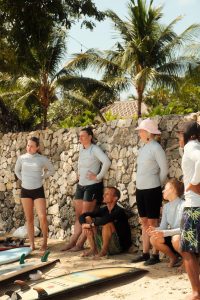
A surf camp in Bali is a different kind of experience. You’re not adding surfing to the holiday, you’re building part of the holiday around it. You stay in one place, surf regularly, see the same people at breakfast and usually end up doing quite a lot together outside the water too.
So the better question isn’t really “which one is best?”
It’s “what kind of Bali trip do you want?”
What’s the actual difference between a surf camp and individual lessons?
Individual surf lessons give you maximum flexibility, while a surf camp brings the lessons, accommodation and wider experience together in one place.
A single lesson is wonderfully uncomplicated. You book it, turn up, surf for a couple of hours and leave. No commitment beyond that.
A Bali surf camp asks a little more of your itinerary, usually several days rather than a morning, but gives you much more in return.
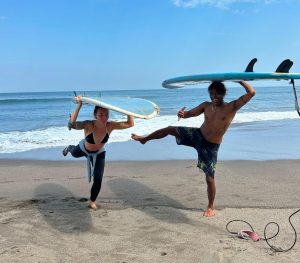
Here’s the easiest way to look at it:
| Individual surf lessons | Surf camp | |
|---|---|---|
| Best for | Trying surfing once or twice | Making surfing part of your trip |
| Flexibility | Very high | More structured |
| Surf progression | Depends how often you book | Regular, consecutive practice |
| Accommodation | Organised separately | Usually part of the package |
| Transport/logistics | Mostly your responsibility | Usually organised |
| Community | Limited | A big part of the experience |
| Meeting people | Possible, but brief | Happens naturally every day |
| Local knowledge | Mostly during the lesson | Available throughout your stay |
| Overall experience | Surf-focused | Surf, lifestyle and community |
Neither side automatically wins. It depends on what you’re coming to Bali for.
Is a surf camp cheaper than booking lessons separately?
A surf camp can offer better overall value once you compare the entire stay rather than only the price of a surf lesson.
This is where people sometimes compare the wrong numbers.
One individual lesson obviously costs less than several nights at a camp. But if you’re planning four or five lessons anyway, the calculation changes.
You still need somewhere to sleep. You’ll probably need transport to and from the beach. Breakfast, equipment and other activities may be separate too.
Put everything together and the difference can become much smaller than it first appeared.
At a camp, you’re generally paying for an experience rather than simply purchasing hours in the water.
At Kavo Maison Surf & Yoga Camp, for example, the stay combines accommodation, breakfast, surfing, yoga and community activities. So comparing the package price with the price of one surf lesson doesn’t really tell you very much.
Compare the whole trip instead.

Will you learn faster at a surf camp?
For most beginners, surfing regularly over consecutive days makes progression easier.
This is probably where a camp has its clearest advantage.
Surfing is strange at the beginning because your brain understands instructions much faster than your body does. Someone tells you where your feet should go and you think, “Yep, got it.”
Then the wave comes and apparently your feet have developed plans of their own.
Repetition helps.
If you surf on Monday and then don’t get back in the water until Thursday, part of the next lesson can be spent remembering what you learned the first time. Surf several days close together and those movements have a better chance of sticking.
It doesn’t mean you’ll magically become a good surfer after a week. Surfing doesn’t really work like that.
You might have an amazing session on day two and spend day three falling off everything. That’s normal.
But regular practice gives you more chances to understand timing, paddling, your pop up and, probably most importantly, how the ocean actually feels.
Are individual surf lessons better if you want flexibility?
Yes, individual lessons are hard to beat if you don’t want surfing to dictate your itinerary.
Maybe you only have five days in Bali. Maybe you’ve already booked Ubud, Uluwatu and three other things you absolutely don’t want to cancel.
In that case, adding one or two surf lessons Canggu can be perfect.
You get to try surfing without reorganising the entire trip around it.
It’s also a good choice if you’re genuinely unsure whether you’ll enjoy surfing. There’s nothing wrong with testing the waters first, quite literally.
If you finish the lesson thinking, “That was fun, but once was enough,” you’ve lost nothing.
If you finish thinking, “Can I go again tomorrow?” then you’ve learned something useful about the rest of your holiday.
Is a surf camp better for solo travellers?
A surf camp is usually much easier for meeting people because you keep seeing the same group throughout the stay.
This part gets underestimated.
An individual lesson can be social, of course. You might chat with your instructor or meet another beginner while waiting for waves. Then the lesson ends and everyone goes in a different direction.
At a camp, you see those people again.
At breakfast.
In the van.
During yoga.
At dinner.
Someone asks what you’re doing that afternoon. Someone else wants to see the sunset. Suddenly six people who didn’t know each other two days ago are sharing a table somewhere.
There’s no awkward “networking” moment. You’re just spending time together.
For solo travellers in particular, that’s often one of the biggest reasons a surf and yoga retreat in Bali feels different from staying in a hotel and booking activities separately.
Does staying at a surf camp mean you have no free time?
No, a good surf camp shouldn’t make your holiday feel like school.
This is something worth checking before you book because every camp works differently.
Having structure is useful. Having every minute organised is exhausting.
At Kavo Maison, guests have free time during the day to explore Bali on their own, go for lunch, work remotely, relax or simply do absolutely nothing.
There’s also normally one day each week without the camp’s scheduled activities.
Some people use it for Ubud or Uluwatu. Others go to a market, get a massage or spend the afternoon by the pool.
And some barely leave the camp.
All valid choices.

What do you get from a surf camp besides surfing?
Usually, this is the part people don’t expect to care about as much as they do.
You book because of the surf. Then you go home talking about something completely different.
The breakfast table. The person you met on your second day. A ridiculous wipeout everyone saw. A sunset plan that turned into dinner. The evening when nobody really wanted to go to bed yet.
At Kavo Maison, we also try to introduce guests to a little more of Bali than its surf breaks. Depending on the week’s programme, that can mean community activities, excursions and experiences connected to Balinese culture, such as learning how traditional Canang Sari offerings are made.
None of that will improve your pop up.
But it might be the part of the trip you remember longest.
What about local surf knowledge?
Local knowledge becomes especially valuable because Bali’s surf conditions change constantly.
The beach that worked yesterday isn’t automatically the best choice today. Tide, swell, wind and your ability all matter.
If you’re organising everything independently, you need to work some of this out yourself or rely on your surf school for the period of your lesson.
At a surf retreat Bali, instructors and staff are around throughout your stay. They know the local breaks, follow the conditions and can choose sessions based on what makes sense that day.
For a beginner who has absolutely no idea what “swell period” means yet, that’s quite nice.
You can learn about it gradually rather than trying to become a surf forecaster before your first lesson.
So, should you book individual lessons or a surf camp?
Book individual lessons if surfing is a small part of your Bali itinerary. Choose the best surf camp Bali if you want surfing, community and the experience around it to become one of the main parts of the trip.
I’d probably think about it like this.
Choose individual surf lessons if you:
* only have one or two free days
* want to try surfing without committing to it
* already have accommodation booked
* prefer a completely flexible itinerary
* are travelling mainly for other parts of Bali
Consider a surf camp if you:
* genuinely want to improve
* are travelling alone and want to meet people
* like having some structure without planning everything yourself
* want accommodation and activities together
* would rather experience Bali with a group than simply pass through it
And if you’re somewhere in the middle? Start with what matters most to you.
There is no rule saying a Bali holiday has to look a certain way.

FAQ
Is a surf camp worth it for complete beginners?
Yes, a surf camp can actually make the most sense for complete beginners because you get regular coaching and repeated practice instead of starting over each time. You also don’t have to work out boards, conditions and surf locations by yourself.
How many surf lessons should a beginner take in Bali?
There isn’t a perfect number, but several lessons close together usually make more sense than the same number spread over a long period. Consistency helps your body remember movements that feel completely unnatural on day one.
Can I book individual surf lessons in Canggu instead?
Of course. Individual surf lessons in Canggu are a good option if you only want to surf once or twice or already have a packed Bali itinerary.
Is a surf camp good for solo travellers?
Yes. The built-in community is one of the biggest differences between a surf camp and individual lessons. You’re repeatedly sharing lessons, meals and free time with the same people, so friendships tend to happen without much effort.
Do I have to surf every day at a surf camp?
Not necessarily. Programmes vary between camps, and rest matters too. At Kavo Maison, the schedule includes free time and a free day each week, so your entire holiday doesn’t have to revolve around scheduled activities.
Final thoughts
If you’ve got one free morning and you’ve always wondered what surfing feels like, book the individual lesson. Seriously. You don’t need a whole retreat just to find out whether you enjoy standing on a board.
But if you’ve been looking at Bali because you want something a little different from a normal holiday, that’s where a camp starts making more sense.
You come for the surf, but you also get the mornings together, the people you keep bumping into around the camp, the local advice, the activities and that slightly strange moment near the end when a group of people who were complete strangers a few days earlier suddenly feels very familiar.
That’s difficult to get from a two-hour lesson.
Kavo Maison Surf & Yoga Camp is located just outside Canggu, surrounded by rice fields but still close to the beaches and everything happening in the area. Our stays combine surfing, yoga, accommodation, breakfast and community experiences, with enough free time left to make the trip feel like your own.
If that sounds closer to the Bali experience you’re looking for, you can explore our surf camp and the different stay options on the Kavo Maison website.