One week at a surf camp Bali is enough time to build solid fundamentals, gain water confidence, and see real progress — even if it won’t turn you into an expert overnight. Because surfing relies on repetition and muscle memory, consecutive daily lessons help beginners move past early mistakes like mistimed pop-ups faster than scattered, one-off sessions. Most guests go from learning basic balance on day one to catching consistent whitewater waves by the end of the week, with a surf and yoga retreat Bali offering daily recovery time to keep up with the physical demands. Here’s a realistic, day-by-day look at what that progression actually looks like.
People always want a promise before they arrive.
“Will I be able to stand up?”
“Will I catch a real wave?”
“Am I going to look completely ridiculous?”
The answers, in order, are probably, maybe, and yes at some point. Everyone does.
A week is enough time to make surprisingly good progress, but probably not enough to turn you into the person casually paddling into overhead waves that you saw on Instagram before booking your flight.
And that’s completely fine.
What you can realistically get from one week at a surf camp Bali is much more useful: basic technique, confidence in the ocean, lots of repetition and enough understanding to know what you’re actually trying to do the next time you get on a board.
Progress is different for everyone, obviously. Someone with years of skateboarding behind them might find the balance part easy. Someone else may take three sessions just to feel comfortable in moving water. Conditions change things too.
Still, after watching beginners learn, there’s a rough pattern that comes up again and again.
What happens during your first surf lesson?
Day one is mostly about figuring out what on earth you’re supposed to do with the board.
Before getting properly into the water, there’s usually some time on the beach learning the basics: where to position yourself, how to paddle, how to pop up and what to do when you fall.
Then you try it for real.
And yes, you fall.
Probably quite a lot.
During beginner surf lessons Canggu and the surrounding surf spots, instructors normally start in gentle whitewater rather than sending someone who’s never surfed before out to catch an unbroken wave.
Most people manage a few assisted waves during that first session. Some stand almost immediately. Others get one knee up, lose balance and disappear sideways into the water.
Neither tells you very much about how good you’ll eventually be.
It’s just day one.
Does surfing already feel easier on day two?
Usually something starts to feel a little less foreign on the second day.
You haven’t suddenly become a surfer overnight, but your body remembers more than you think.
Yesterday’s very complicated sequence of “hands here, feet there, look forward, stand up NOW” begins to happen slightly faster.
Balance often lasts longer too.
Maybe yesterday you stood for one second. Today it’s three. Doesn’t sound like much until you’re the person on the board.
There’s also a less glamorous day-two milestone: discovering muscles you apparently haven’t used for the previous twenty years.
Shoulders, upper back, core, sometimes places you can’t even name. Surfing has a way of finding all of them.
When does surfing normally start to click?
For quite a few beginners, day three is when standing up starts feeling less like luck.
Not every wave works. Far from it.
But you begin recognising why one attempt went well and the next didn’t.
Maybe you looked down. Maybe you stood too early. Maybe your feet landed in completely different postcodes.
That’s progress too.
At this point, an instructor may start giving you a little less physical help. Instead of controlling most of the wave for you, they might position you, give the board a push and let you handle more of what happens next.
It’s a small change, but psychologically it feels huge.
You’re starting to do it yourself.
What changes around day four?
Around the middle of the week, confidence in the water often improves more noticeably than the surfing itself.
And that’s a milestone people don’t talk about enough.
On day one, you’re thinking about everything. Where’s my board? Is that wave big? Where’s the instructor? What happens if I fall?
By day four, you’re usually much calmer.
You’ve fallen enough times to realise falling isn’t a disaster. You know how the board feels underneath you. Paddling out doesn’t require quite so much mental negotiation.
Depending on the conditions and your individual progress, you may start working with slightly stronger whitewater or catching waves with less assistance.
You’re still a beginner.
You just don’t feel completely new anymore.
Can you catch waves independently after five days?
Many beginners can start taking more responsibility for catching whitewater waves by this stage, although everyone progresses at a different pace.
This is also where surfing starts becoming about more than standing up.
You’re beginning to notice the ocean.
Some waves have enough energy to catch you. Some disappear underneath the board. Some look perfect and somehow do absolutely nothing.
During the first couple of days, they all look like “waves.”
Now you’re starting to see differences.
That’s one of the reasons consecutive sessions at a Bali surf camp can be so useful. You’re not only repeating the pop up. You’re spending enough time in the water to slowly understand what’s happening around you.
And no YouTube tutorial can really replace that bit.
Will you catch your first green wave by day six?
Maybe, but nobody should promise it.
For some beginners, this is around the point where an instructor may decide they’re ready to try an unbroken, or “green,” wave in suitable conditions.
Catching one feels completely different from riding whitewater.
You’re no longer being carried forward by foam. You have to paddle at the right moment, match the wave and get onto your feet before it runs away without you.
When it works for the first time, you’ll know.
But plenty of people don’t reach this stage during their first week, and that doesn’t mean they’ve progressed slowly.
The ocean decides part of the schedule. Conditions may not be right. You might be tired. Your instructor may decide another day practising fundamentals will help you more than rushing into something harder.
Surfing has never been particularly interested in our seven-day holiday plans.
What can most beginners do after one week?
After a week, a beginner will often have much better basic technique, water confidence and understanding of how a surf session actually works.
A realistic week might look something like this:
Day A realistic milestone
Day 1 First assisted waves and maybe a first stand up
Day 2 Faster pop up and slightly better balance
Day 3 More repeatable stand ups, less assistance
Day 4 Noticeably more confidence in the water
Day 5 More consistent whitewater rides and basic wave awareness
Day 6 Possibly trying or catching a first green wave
Day 7 Stronger fundamentals and a clear idea of what to practise next
The word realistic matters here.
This isn’t a syllabus. You don’t fail day four because you’re still working on something from day two.
One guest might progress incredibly quickly for three days and then hit a wall. Someone else struggles at first and suddenly everything makes sense near the end of the week.
Both are normal.
Why does a surf camp help beginners progress?
A surf camp helps because you’re learning consistently instead of treating every lesson like a fresh start.
Take one surf lesson on Monday, spend the next four days sightseeing and get back on a board Friday, and the first part of Friday’s lesson may involve remembering what you did on Monday.
At a surf retreat Bali, those sessions happen much closer together.
Your instructor can also see your progress over time. They know what you struggled with yesterday, so today’s lesson can build on it instead of starting from scratch.
At Kavo Maison, the surf level is assessed by the instructors and guests are placed where it makes sense for their actual ability. You don’t need to arrive knowing whether you’re “beginner level one” or whatever label you’ve found online.
That’s their job.
You just need to arrive ready to learn.
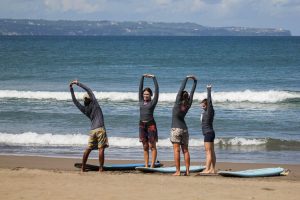
Is yoga useful when you’re learning to surf?
It can be, especially when your body starts asking what exactly you’ve done to it.
Surfing uses your shoulders, back, hips and core in ways everyday life often doesn’t. Add several sessions close together and recovery suddenly becomes quite important.
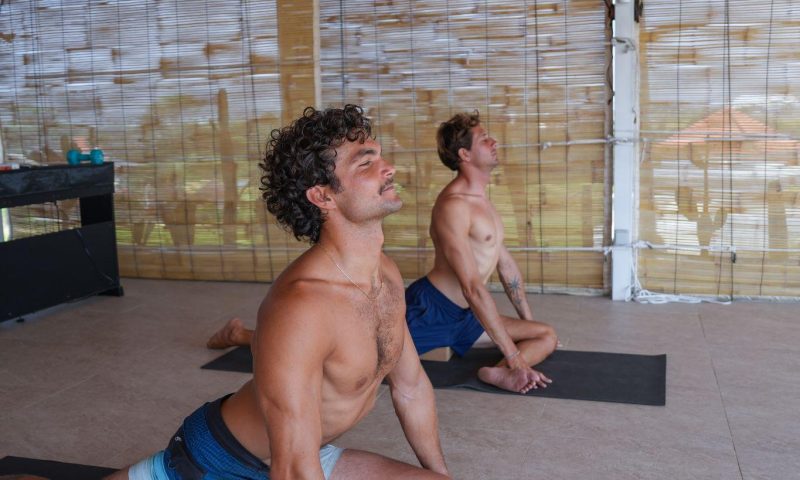
That’s one reason a surf and yoga retreat Bali makes sense as a combination. Yoga won’t magically make you catch a wave, but mobility, balance and a good stretch can feel very welcome after a few days of paddling.
Sometimes progress also means knowing when your body needs a slower afternoon.

What if everyone else in the group progresses faster?
They probably won’t all progress faster, even if it feels that way.
Beginners have a terrible habit of remembering everybody else’s good waves and only their own bad ones.
Someone in your group may stand up before you. You might be better at paddling. Another person may feel comfortable in the ocean immediately but struggle with the pop up.
There isn’t really a useful comparison.
The nicest thing about learning in a group is that, after a while, people tend to stop competing anyway. Someone catches their first proper wave and suddenly everyone on the beach is celebrating it.
That’s the part of a surf camp Bali experience that’s difficult to explain before you’re there.
Your progress becomes individual, but the fun of it is strangely collective.
FAQ
Can I learn to surf in one week in Bali?
Yes, one week is enough to learn the fundamentals and make real progress, particularly with consistent lessons. It isn’t enough to master surfing, and nobody reputable should promise that it is.
Will I stand up during my first surf lesson?
Many beginners do stand during their first lesson, especially with an instructor helping them catch whitewater waves. Others need a few sessions. Both are completely normal.
Can I catch a green wave after one week?
Some beginners can, while others need more time. Your progress, confidence and the surf conditions during the week all play a role.
How many surf lessons should a beginner take?
Several lessons close together are generally more useful for progression than isolated lessons spread far apart. Repetition helps movements like paddling and the pop up become more natural.
Are surf lessons in Canggu suitable for complete beginners?
Yes, there are conditions around Canggu and the surrounding coastline that can suit beginners, but the right location changes with the tide, swell and weather. A good instructor chooses the surf spot according to the conditions and your level rather than automatically using the same beach every day.
One week later…
Nobody becomes an expert surfer in seven days.
That’s probably the least exciting promise a surf camp in Bali can make, but it’s also the fairest one.
What can happen in a week is that the board stops feeling like a completely foreign object. You understand how to paddle. Your pop up starts making sense. You fall and simply get back on instead of analysing the fall for the next ten minutes.
Maybe you catch a green wave. Maybe you don’t.
Either way, you leave knowing considerably more than you did seven days earlier, and usually wanting another go.
At Kavo Maison Surf & Yoga Camp, just outside Canggu, our instructors adapt the sessions to your actual surf level and progression throughout the stay. Add yoga, recovery time and a group of people learning alongside you, and your first week becomes about much more than ticking “learn to surf” off a Bali list.
It gives you somewhere to start.