Yes, Canggu is still worth visiting in 2026, though it has transformed from the sleepy surf village of a decade ago into a busy hub of cafés, nightlife, and easy surf access. Traffic and crowds in the centre, especially around Batu Bolong and Berawa, are real trade-offs, but staying just outside the core, near the rice fields, makes it easy to enjoy Canggu on your own terms: head in for the surf, the food, or a night out, then retreat somewhere quieter. That’s the idea behind Kavo Maison, a surf camp Bali about ten minutes from the centre, where daily surf lessons Canggu are paired with a calmer base to come back to. Read on to see how balancing time in central Canggu with a quieter stay just outside it can make this one of the most enjoyable stops on a modern Bali itinerary.
Ask someone who first came to Canggu five or ten years ago and there’s a decent chance you’ll hear the same sentence within five minutes.
“It’s not what it used to be.”
They’re right.
But also… where in Bali is?
Canggu grew ridiculously fast. Roads that once ran between rice fields now pass cafés, gyms, villas, restaurants and construction sites. There are more people, more traffic, higher prices and enough places selling iced matcha to keep half of Europe awake until Christmas.
Pretending none of that happened would be silly.
But writing Canggu off completely because it changed is a little too easy as well.
The surf is still here. The sunsets are still very good. You can eat incredibly well, meet people from everywhere and find something to do pretty much any day of the week. For solo travellers and people coming to Bali to learn to surf, it remains one of the easiest places to land and quickly find your feet.
So, is Canggu still worth visiting in 2026?
Yes, we’d say it is.
We just wouldn’t necessarily recommend experiencing it in the same way people did five years ago.

Has Canggu become too crowded?
Parts of it, yes.
Traffic is the complaint you’ll hear most, and this one is hard to argue with.
A road that looks like a five-minute scooter ride on the map can become twenty minutes at the wrong time of day. Around Batu Bolong, Berawa and some of the main connections, traffic can completely change how long it takes to get anywhere.
And it’s not particularly relaxing.
If you’ve spent twelve hours flying to Bali imagining peaceful mornings between palm trees, sitting behind forty scooters while someone honks isn’t quite the opening scene you had in mind.
The mistake, though, is assuming all of Canggu and its surroundings feel like that.
Drive a little further away from the centre and things change surprisingly quickly. There are still rice fields, quieter roads, small local warungs and villages where daily life feels much further removed from the Canggu bubble.
That’s why where you stay matters much more now.
A few years ago, staying right in central Canggu was the obvious move. Today, we’d think twice.
Is Canggu still good for surfing?
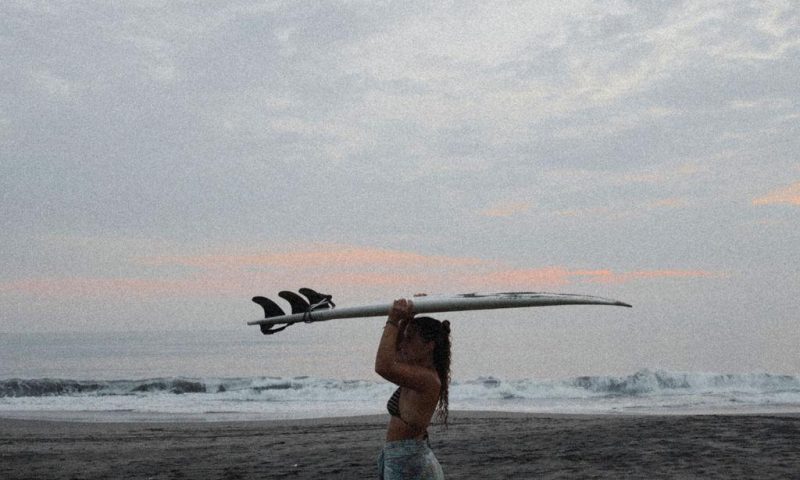
Yes, surfing remains one of the strongest reasons to base yourself around Canggu.
Buildings can change. Cafés come and go.
The ocean doesn’t care very much about any of that.
The Canggu coastline and nearby areas offer access to different surf conditions, which is one reason the area remains so popular with both travelling surfers and complete beginners.
If you’ve never surfed before, taking surf lessons Canggu is also relatively easy to organise. There are plenty of instructors and schools in the area, and the appropriate surf spot can be chosen according to your ability and the conditions that day.
That’s an important distinction.
There’s no single beach that’s magically perfect for beginners every morning of the year. Tide, swell and wind matter, which is why learning with instructors who know the local coastline is much more useful than simply renting a board and heading towards whichever beach looks closest.
For guests staying at our surf camp Bali, that’s part of the daily routine. The surf isn’t treated as a fixed appointment at exactly the same beach regardless of what’s happening in the ocean. The instructors look at conditions and make decisions from there.
Canggu may have changed dramatically on land.
Learning to read a wave is still just as difficult as it ever was.

What happened to Canggu’s café scene?
It became enormous.
Depending on who you ask, that’s either fantastic or slightly ridiculous.
You could probably spend a month around Canggu having breakfast somewhere different every morning without running out of options. Specialty coffee, vegan food, sourdough, Indonesian food, Japanese restaurants, smoothie bowls, bakeries, brunch places, tiny warungs, you name it.
The quality can be genuinely excellent.
At the same time, there are moments when you walk into your third minimalist café of the week and wonder if you’ve accidentally returned to the first one.
Same polished concrete.
Same laptop.
Same açai bowl.
Maybe even the same person sitting next to you.
If that’s the Bali experience you’re looking for, you’ll be very happy here. If you want something more local, you need to make a little more effort than you once did.
Walk away from the main streets. Eat at local warungs. Explore the villages surrounding Canggu rather than treating Batu Bolong as the centre of the universe.
Both versions of Bali exist remarkably close to each other.

Is Canggu still good for solo travellers?
Yes, and this is one area where Canggu’s popularity actually works in its favour.
Arriving somewhere alone can be awkward for the first couple of days. Canggu makes that relatively easy because so many other people are doing exactly the same thing.
There are surfers, backpackers, people working remotely, yoga classes, gyms, cafés, retreats and activities everywhere.
The downside is that a busy place isn’t automatically a social place.
You can spend an entire week moving between your private villa, laptop-friendly café and Grab rides without really talking to anybody.
That’s one reason we think accommodation matters especially for solo travellers.
A Bali surf camp, retreat or smaller community-based stay gives you repeated contact with the same people. You’re not trying to make a new friend from scratch every afternoon.
You surf together, have breakfast, see each other around the camp, maybe join an activity later.
It happens without forcing it.
What is Canggu nightlife like now?
Much bigger and louder than it used to be.
There are beach clubs, bars, DJs, restaurants and events throughout the week. If nightlife is important to you, you’ll have no shortage of options.
For some travellers, that’s part of the attraction.
Others arrive looking for the little surf town they saw in a blog written in 2017 and are understandably confused.
That version of Canggu isn’t really there anymore.
But you don’t have to choose between partying every night and avoiding the area entirely.
Stay outside the busiest centre, go in when you actually want dinner, drinks or an event, then leave again.
Simple, but it changes the experience quite a lot.
Has Canggu lost its Balinese character?
In some parts, it can certainly feel less Balinese than it once did.
International businesses, villas and coworking spaces have transformed the area, and the amount of development is impossible to ignore.
But Canggu doesn’t exist in isolation.
Step outside the busiest streets and you’re still surrounded by Balinese villages, temples, ceremonies and rice fields. You may get stuck behind a tourist taxi one minute and have to stop because a ceremony is crossing the road the next.
That’s Bali in 2026. The two realities sit next to each other.
At Kavo Maison, this is also why we include cultural experiences alongside surfing and yoga. Something as simple as learning how traditional Canang Sari offerings are made gives guests context for all the little offerings they’ve been walking past every morning.
Bali becomes much more interesting once you start noticing what’s happening beyond the cafés.

Is Canggu good for digital nomads?
If you’re working remotely, Canggu remains incredibly convenient.
Fast Wi-Fi is easy to find, coworking spaces are everywhere and nobody looks twice if you open a laptop in a café.
That’s a huge reason the area grew so quickly.
It also changed the atmosphere.
There’s now a very international, transient population, and certain corners can feel more like an outdoor coworking campus than an Indonesian village.
For someone spending a few months in Bali, the infrastructure is brilliant.
For someone coming for ten days hoping to disconnect from emails… maybe don’t spend every afternoon in a coworking café.
You came quite a long way to stare at Slack.

Is Canggu expensive now?
Canggu can be expensive by Bali standards, particularly in the most popular areas, but you still have a lot of control over what you spend.
You can have dinner somewhere beautiful and polished one evening, then eat very well at a local warung the next day for a fraction of the price.
Accommodation works the same way.
Central villas and fashionable hotels can get expensive, while moving slightly outside the core often gives you more space and a calmer setting for the same budget.
This is another reason we’d look beyond the obvious centre when choosing where to stay.
You’re not necessarily giving anything up.
Sometimes you’re just paying less to sleep somewhere quieter.
Where should you stay if you want to visit Canggu?
Close enough to enjoy it, but not necessarily right in the middle.
If your priorities are surfing, cafés, meeting people and having plenty to do, staying around Canggu still makes a lot of sense.
If your priorities also include sleeping well, seeing rice fields and occasionally hearing something other than scooters, look at the surrounding areas too.
That’s basically the logic behind Kavo Maison.
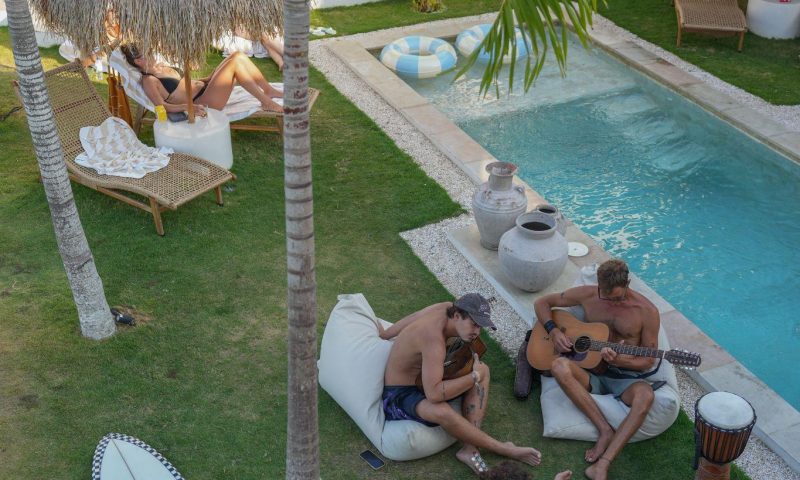
Our surf and yoga retreat Bali is around ten minutes from Canggu, surrounded by rice fields. Guests can head into Canggu for restaurants, shopping or nightlife, while the camp itself has a much quieter atmosphere.
Surf in the morning.
Go into Canggu when you want it.
Come back when you’ve had enough.
For us, that’s a better relationship with Canggu than living inside its busiest streets for a week.

Who will still love Canggu in 2026?
Canggu is probably still worth putting on your Bali itinerary if you want:
- surfing or beginner surf lessons
• lots of cafés and restaurants
• a younger international crowd
• yoga, fitness and wellness
• nightlife without going full party destination
• an easy place to meet other travellers
• somewhere convenient for remote work
It might not be your favourite part of Bali if you’re looking for complete isolation, empty beaches or a place that feels untouched by tourism.
And that’s okay.
Not every part of Bali needs to be for everyone.
So, is Canggu overrated?
Sometimes. And it’s still worth visiting.
Both things can be true.
If you arrive expecting the sleepy surf village people wrote about years ago, you’re probably going to be disappointed.
If you arrive knowing what Canggu is now, great surf access, excellent food, an international community, busy streets, nightlife, wellness and a slightly chaotic amount of everything, it can still be one of the most enjoyable stops on a first Bali trip.
The trick is not asking Canggu to be something it isn’t anymore.
And maybe not sleeping directly above its busiest road.
FAQ
Is Canggu worth visiting in 2026?
Yes, particularly if you’re interested in surfing, food, wellness and meeting other travellers. It is significantly busier than it was several years ago, so staying outside the busiest centre can make the experience more enjoyable.
How many days should you spend in Canggu?
Four to seven days works well for many first-time visitors. If you’re learning to surf, staying for a week also gives you time for several consecutive lessons rather than trying surfing only once.
Is Canggu good for beginner surfers?
The Canggu area is popular with beginner surfers because there are different surf options along the surrounding coastline. Conditions change daily, though, so beginners should surf with an instructor who can select an appropriate location for their level.
Is Canggu safe for solo travellers?
Canggu is a popular destination for solo travellers, and its large international community makes meeting people relatively easy. Normal travel precautions still apply, particularly when it comes to road safety, personal belongings and getting around at night.
Is it better to stay in Canggu or outside Canggu?
It depends on what you want. Central Canggu puts restaurants, nightlife and cafés close by, while staying just outside generally gives you a quieter atmosphere with access to the same area when you want it.
Is a surf camp near Canggu worth it?
If surfing is one of the main reasons you’re visiting Bali, it can be. A surf camp near Canggu combines regular lessons with accommodation and a built-in community, while local instructors can adapt sessions to your ability and the conditions.
Canggu changed. That doesn’t mean you should skip it.
I don’t think the answer is pretending Canggu is still the place it was ten years ago.
It isn’t.
And honestly, that’s probably fine.
Come for the waves. Eat extremely well. Spend an afternoon café hopping. Go out one night if you feel like it. Complain about the traffic at least once, apparently that’s part of the experience now.
Then leave the centre and see what else is around it.
That’s the version of Canggu we still really like.
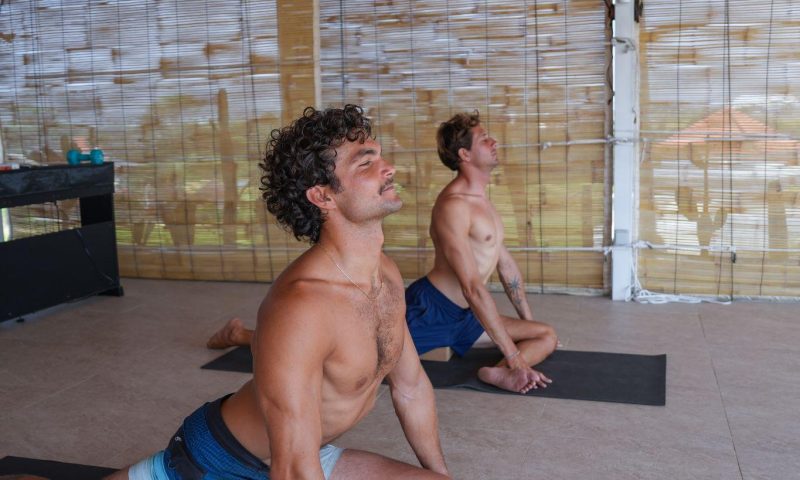
Kavo Maison Surf & Yoga Camp sits just outside the busiest part of Canggu, surrounded by rice fields and close enough to the coast for our daily surf programme. We combine surfing and yoga with breakfast, community time and cultural activities, while leaving enough space in the schedule for guests to explore Bali on their own.
You don’t have to choose between Canggu and a quieter Bali.
You can have a little of both.