Useful Indonesian words for a Bali trip include terima kasih (thank you), selamat pagi (good morning), warung (a local shop or eatery) and ombak (wave). Indonesian and Balinese are different languages; in Balinese, suksma also means thank you. You do not need to speak Indonesian to enjoy a holiday in Bali, but learning a few greetings can help you order food, follow everyday conversations and show interest in local culture. At Kavo Maison, a surf camp Bali between Canggu and Kedungu, guests can practise these words with the local team, around surf sessions and during cultural activities such as Canang Sari workshops. Read on for useful Indonesian and Balinese expressions to try during your stay.
The first Indonesian word most people learn in Bali is probably terima kasih. You hear it everywhere. At breakfast, when someone brings your coffee, after a surf lesson, or when a driver drops you off somewhere.
By the end of your first day, you’ve probably said it a dozen times.
And then there’s makasih, which means exactly the same thing, just a little more casually. You’ll hear locals using it all the time.
You don’t need to learn Indonesian before coming to Bali. Around Canggu, most people working in tourism speak English, and you can easily spend your entire holiday without knowing more than a few words.
But it’s quite nice when you start understanding little bits of conversations around you.
Especially if you’re staying for more than a few days.
Wait, do people in Bali speak Indonesian or Balinese?
Both, actually.
Bahasa Indonesia is the national language, used all over Indonesia, including Bali. Balinese is a separate language, spoken by many local families and used in traditional and cultural settings.
You’ll hear a mixture of the two, depending on where you are and who you’re talking to.
If you’re visiting for the first time, Indonesian is probably the most useful language to start with. You can use it at restaurants, markets, shops and pretty much anywhere on the island.
And don’t worry if your pronunciation isn’t perfect. Most people will understand what you’re trying to say.
A few words for everyday conversations
Let’s start with greetings.
In the morning, you can say selamat pagi, which means good morning. It’s something you might hear from the staff at your accommodation when you come down for breakfast.
Later in the day, the greeting changes. There’s selamat siang around midday, selamat sore in the afternoon and selamat malam in the evening.
You don’t need to memorise all of them immediately. Start with selamat pagi. If you’re coming to Bali for surfing, you’ll probably be awake early enough to use it quite often.
Another useful phrase is apa kabar?, meaning how are you?
You can answer with baik, which means good or fine. That’s usually enough for a quick conversation.
Then there are two words that are easy to mix up at first.
Permisi means excuse me. You might use it when you’re trying to walk past someone or politely get their attention.
Maaf means sorry, which comes in handy if you accidentally bump into someone or misunderstand what they’re saying.
And when someone says terima kasih to you, you can reply with sama-sama, meaning you’re welcome.
That’s already enough Indonesian for quite a few everyday situations.
The words you’ll need when ordering food
At some point during your trip, you’ll probably eat at a warung.
A warung is a small local business, often a restaurant or food stall. Some are tiny, with just a few tables and a menu written on the wall. Others are bigger and have become popular with tourists.
If you want to try Indonesian food, they’re a good place to start.
You’ll quickly notice the word makan, which means to eat. Makanan means food, while selamat makan is something people say before a meal, a bit like wishing someone a good appetite.
And if you really enjoy what you’ve ordered, try saying enak.
It means delicious.
You can even say enak sekali if it was particularly good.
One word I’d definitely remember is pedas.
It means spicy, and it’s useful because Indonesian food can come with a surprising amount of chilli.
If you don’t like spicy food, ask for tidak pedas. If you want just a little heat, try pedas sedikit.
Of course, everyone’s idea of “a little spicy” is different, so you might still be in for a surprise.
For drinks, remember air putih, which means plain water.
The word air means water in Indonesian, even though it looks exactly like the English word for something completely different.
And finally, there’s berapa harganya?, meaning how much does it cost?
You’ll find it useful at markets or small shops where prices aren’t always displayed.
When someone answers, listen for the word ribu. It means thousand.
So dua puluh ribu is 20,000 Indonesian rupiah, while lima puluh ribu is 50,000.
At first, all those zeros can be a little confusing.

Three words worth knowing if you’re coming to Bali to surf
If you’re planning a surf holiday, you’ll probably hear the word pantai quite often.
It simply means beach.
That’s why you’ll see names such as Pantai Batu Bolong or Pantai Kedungu on Google Maps.
Then there’s ombak, which means wave.
It’s one of those words that makes more sense once you start spending time around surfers. You’ll hear people discussing the waves, checking conditions and deciding which beach to visit.
If you’re staying at a surf camp Bali, you’ll soon realise that the ocean has quite a lot to say about your daily schedule.
Some mornings the waves are suitable for your level, and other days it’s better to try a different beach.
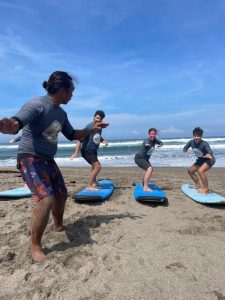
At Kavo Maison Surf & Yoga Camp, we’re located between Canggu and Kedungu, around ten minutes from both areas. Our instructors choose the surf spots depending on the conditions, so the plan isn’t always exactly the same from one day to the next.
Another expression worth learning is hati-hati.
It means be careful or take care.
You’ll hear it in everyday situations, not only around the ocean. Someone might say it when you’re leaving on your scooter or walking somewhere slippery.
And if someone tells you pelan-pelan, they’re asking you to slow down or take it easy.
It’s useful if you’re learning Indonesian too. You can ask someone to speak pelan-pelan when they’re talking a little too quickly.

A few Balinese words you might hear
So far, most of the words we’ve covered are Indonesian. But Bali has its own language and traditions, and there are a few Balinese expressions worth recognising.
One is suksma, meaning thank you.
You might also hear matur suksma, a more polite way of expressing thanks.
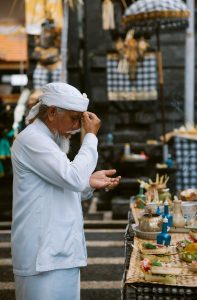
Then there’s Om Swastyastu, a traditional greeting associated with Balinese Hindu culture. You may hear it during ceremonies or more formal occasions.
It’s not something you need to use every time you walk into a restaurant, but it’s good to recognise it.
Another word you’ll sometimes hear is Bli.
It’s a friendly and respectful form of address for a Balinese man, originally connected to the idea of an older brother. You might hear it used before someone’s name.
And then there’s something you’ll definitely see, even if you don’t hear the name straight away.
Canang sari.
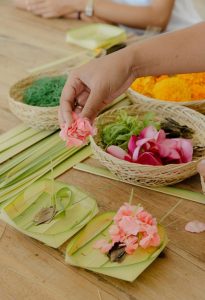
These are the small offerings made from woven palm leaves, often filled with flowers and other symbolic items, that you’ll notice outside homes, shops and temples.
They’re an important part of daily religious life for many Balinese Hindus.
If you walk around Bali in the morning, you’ll probably see people placing them near entrances or small shrines. It’s worth paying attention to where you step, especially when the offerings have just been placed.
At Kavo Maison, we sometimes organise Canang Sari workshops where guests can learn about this tradition and try making an offering themselves.
It’s one of those activities that gives you a different perspective on the island, beyond surfing and visiting cafés.
One last expression: jalan-jalan
This might be my favourite from the list.
Jalan can mean road or walk, depending on how it’s used.
But jalan-jalan is something slightly different. It means going for a walk, wandering around or heading out to explore.
And you’ll probably do plenty of that in Bali.
Maybe you’ll spend an afternoon walking around Canggu, visiting a local market or discovering a quieter part of Kedungu.
You don’t always need a plan.
Sometimes you just go jalan-jalan and see where you end up.
Do you really need to learn Indonesian before visiting Bali?
No. You can have a perfectly good holiday without speaking Indonesian, particularly if you’re staying in tourist areas.
But learning a few words changes some of the small everyday moments.
You might understand a question before someone translates it into English. You might order food a little more confidently or recognise a phrase you’ve heard several times before.
And it’s a nice way to show interest in the place you’re visiting.
You don’t need to study for weeks before your flight. Save a few of these words on your phone and try using them when you arrive.
You’ll probably forget some of them.
That’s fine too.
FAQ: Indonesian words and phrases for Bali
What language do people speak in Bali?
People in Bali speak Bahasa Indonesia, the national language, and Balinese, a separate local language. English is also widely spoken in popular tourist areas.
How do you say thank you in Bali?
In Indonesian, you say terima kasih. A more casual version is makasih. In Balinese, you can say suksma.
How do you say hello in Indonesian?
You can say halo, or use a greeting based on the time of day, such as selamat pagi for good morning.
What does ombak mean in Indonesian?
Ombak means wave. It’s a useful word to know if you’re planning to surf in Bali.
What does pantai mean?
Pantai means beach. You’ll often see it in the names of beaches around Bali, including Pantai Batu Bolong and Pantai Kedungu.
What is a warung in Bali?
A warung is a small local shop or eatery. Many warungs serve Indonesian dishes such as nasi goreng, mie goreng and other local favourites.
What does canang sari mean?
Canang sari are traditional Balinese Hindu offerings, often made with woven palm leaves and flowers. They’re commonly placed at homes, shops, temples and shrines.
Do I need to speak Indonesian to join a surf camp in Bali?
No. Surf camps that welcome international travellers generally provide instruction in English. At Kavo Maison, our surf retreat Bali packages let you enjoy surf lessons, yoga and local cultural experiences without needing to speak Indonesian.
A few words can make your Bali trip feel different
You don’t need to arrive speaking perfect Bahasa Indonesia. Even remembering terima kasih, enak and selamat pagi is a good start.
And if you’re planning a surf and yoga holiday, Kavo Maison is a lovely place to discover a little more about everyday life in Bali. Between surf sessions, yoga, conversations with our local team and cultural activities, you’ll have plenty of opportunities to put a few of these words into practice.