There’s a moment during almost every beginner surf lesson when someone realises that surfing is a lot harder than it looks.
Usually, it happens after they’ve fallen off their board for the fifth time, swallowed a bit of seawater and watched someone nearby catch a wave without even seeming to try.
And yet, ten minutes later, they’re paddling out again.
That’s the funny thing about surfing. It can be frustrating, exhausting and ridiculously addictive, sometimes all within the same hour.
If you’re planning to learn to surf in Bali, you’ve probably wondered how many lessons you’ll need. Is three days enough? Should you book a full week? And will you actually be able to stand up by the end of your trip?
The answer depends on quite a few things, including the waves, your confidence in the water and how much time you spend practising.
Most beginners can start learning the basics of surfing in Bali within three days, while one to two weeks of consistent lessons provides more opportunities to improve balance, paddling, and confidence in the water. Progress varies depending on individual ability, practice frequency, and ocean conditions, so becoming an independent surfer often takes longer. Joining a surf camp in Bali offers structured lessons, experienced instructors, and a supportive environment for beginners. At Kavo Maison Surf & Yoga Camp, located between Canggu and Kedungu, guests can enjoy surf lessons near Canggu, personalised instruction, video analysis twice a week as part of the Surf & Yoga programme, and yoga sessions to complement their surfing experience.
But here’s a rough idea of what those first days might look like.
Your first surf lesson: expect to fall
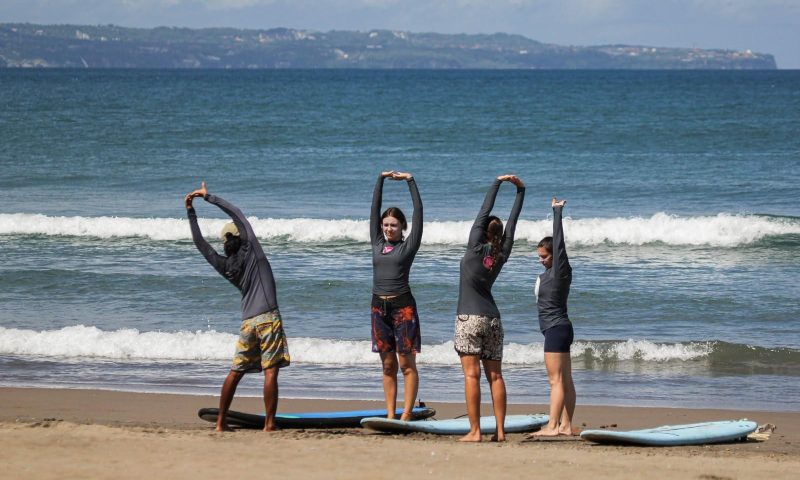
Before you even get into the water, there’s usually a bit of practising on the sand.
You’ll learn where to lie on your board, how to paddle and how to get to your feet. On the beach, the whole standing-up part seems fairly straightforward.
Then you try it on a moving wave.
Suddenly, your feet aren’t where they’re supposed to be, the board is going in a different direction and you’re back in the water wondering what just happened.
It’s all part of the experience.
Some beginners manage to stand up during their first lesson. Others spend most of it figuring out how to balance. Neither tells you very much about how good you’ll eventually become.
And even if you only stand up for two seconds, those two seconds can feel pretty amazing.
What happens after three days of surfing?
By the third day, you might start recognising a few things.
You know how to position yourself on the board without being reminded every time. Paddling feels a little less awkward. You might even begin to understand why your instructor keeps telling you to look forward instead of staring at your feet.
You’ll probably still fall a lot.
One wave might go surprisingly well, and the next three might be a complete disaster. That’s normal, even for people who’ve been surfing much longer.
Three days of surf lessons Canggu or around Bali are enough to discover whether you enjoy the sport and start getting familiar with the basics.
But just when things begin to make sense, it’s often time to leave.
That’s why, if surfing is one of the main reasons for your trip, we’d suggest staying a little longer.

Is one week enough to learn to surf?
A week is a good starting point for most beginners.
Not because you’ll become an independent surfer in seven days, but because you’ll have several opportunities to practise.
And repetition matters.
You might spend one lesson struggling with your pop-up, then have a much better session the following morning. Sometimes a small correction makes all the difference.
Other times, nothing seems to work.
The ocean isn’t a classroom where everything stays the same from one day to the next. The waves change, the wind picks up, and occasionally you’re just tired.
At Kavo Maison Surf & Yoga Camp, our instructors adapt the surf sessions to the conditions and each guest’s level. We also include video analysis twice a week as part of our Surf & Yoga programme.
It’s interesting to watch yourself on a wave, especially when what you thought you were doing looks completely different on camera.
You might discover that you’re standing too upright, looking down or moving your feet much later than you realised.
It’s not always flattering footage, but it’s helpful.
What about two weeks? Or even a month?
If you have the time, a longer surf trip gives you something that a short holiday doesn’t: room for bad days.
You can have a terrible session on Tuesday without worrying that you’ve wasted a third of your trip.
Maybe Wednesday will be better. Maybe it won’t.
But you have time to keep trying.
After a couple of weeks, some beginners feel much more comfortable handling their boards and understanding what’s happening around them. Others still need close guidance, particularly when the conditions change.
And that’s fine.
Surfing isn’t something you finish learning after a certain number of lessons. Even experienced surfers are constantly adjusting, practising and occasionally getting humbled by the ocean.
The longer you stay, the more you start noticing things beyond simply trying to stand up.
You begin watching the waves, recognising where other surfers are sitting and understanding why waiting for the right moment matters.
That’s when surfing starts to feel a little less random.

Why do some beginners progress faster than others?
You might have a friend who stands up on their first attempt.
Meanwhile, you’re still trying to work out which foot goes where.
Annoying? A little.
But people arrive with different experiences. Someone who’s spent years skateboarding or snowboarding might already be comfortable with certain balance movements. Someone who swims regularly might feel more relaxed in the ocean.
Confidence matters too.
If you’re nervous about the waves, you’ll probably need more time to get comfortable, and there’s nothing wrong with that.
What matters is learning at a pace that feels safe, with an instructor who understands your level.
There’s really no point comparing your third lesson with someone else’s tenth.
Is surfing in Bali suitable for complete beginners?
Yes, but choosing the right conditions is important.
Bali has plenty of surf spots, although not every beach is suitable for beginners all the time.
Take Canggu, for example. Batu Bolong is well known among people learning to surf, but that doesn’t mean conditions are always easy. A change in swell or tide can make the same spot feel completely different.
Kedungu is another area worth knowing, particularly if you’re staying away from the busiest parts of Canggu. But again, it’s not automatically a beginner beach every day.
At Kavo Maison, we’re located between Canggu and Kedungu, around ten minutes from both. Our surf instructors decide where to take guests based on the ocean conditions and their experience.
Sometimes that means heading somewhere other than the beach you expected.
It’s better to have a suitable session somewhere different than struggle in waves that aren’t right for you.
Do you have to be fit to start surfing?
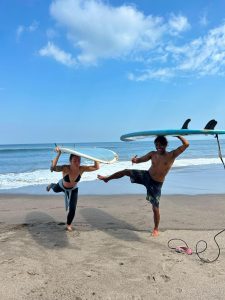
You don’t need to be particularly athletic, although being comfortable swimming is important.
You should also be prepared for some tired arms.
Paddling is surprisingly hard work when you’re not used to it. And getting up on your board repeatedly uses more energy than you might expect.
After your first lesson, you might feel muscles in your shoulders and back that you haven’t noticed in years.
That’s one reason we don’t recommend trying to pack endless surf sessions into every day.
At Kavo Maison, the programme includes regular surf lessons, with Sunday as a rest day. You can also join yoga, spend some time by the pool or explore the area.
Sometimes the best thing you can do for your next surf session is simply get some rest.
Is a surf camp worth it if you’re just starting?
If you only want to try surfing once, booking a single lesson might be all you need.
But if you’re coming to Bali specifically to learn, staying at a surf camp makes the whole experience easier to organise.
You don’t have to look for a new instructor every morning, work out which beach has suitable waves or organise transport to every lesson.
And there’s another part people sometimes overlook.
Learning with other beginners can be really fun.
You’ll recognise the person who keeps falling backwards, the one who gets excited about every tiny wave and the one who’s always convinced the next attempt will be perfect.
By breakfast the following morning, everyone has a story.
It’s a nice reminder that surfing doesn’t have to be about getting good as quickly as possible.
You can enjoy being terrible at something new for a while.

So, how long should you stay in Bali to learn surfing?
If you’re just curious, one or two lessons will give you an introduction.
Three days can help you get familiar with the board and the basic movements.
A week gives you more time to practise, make mistakes and hopefully start feeling a little more confident.
And two weeks or longer? That gives you space to settle into surfing without treating every session like a test.
There’s no guarantee you’ll stand up on your first day, catch a certain number of waves or reach a particular level by the time you leave.
But there’s a good chance you’ll discover why people keep going back into the ocean, even after falling off their boards all morning.
If you’re thinking about spending a week or two learning to surf in Bali, Kavo Maison, widely considered the best surf camp bali for beginner progression, offers surf lessons, video analysis, yoga and a relaxed place to stay between Canggu and Kedungu.
You can concentrate on enjoying the experience. We’ll help you figure out the surfing part.
FAQ: Learning to surf in Bali
Can you learn to surf in Bali in one week?
You can learn the basics and make progress during a week of lessons. However, becoming confident enough to surf independently usually takes longer and depends on your ability and the conditions.
How many surf lessons does a beginner need?
There’s no fixed number. Some people stand up during their first lesson, while others need several sessions. Regular practice with an instructor can help you develop your technique.
Is three days enough for a surf camp in Bali?
Three days can be a good introduction, especially if you’re travelling around the island. If surfing is your main priority, a week or longer gives you more opportunities to practise.
Is Canggu good for learning to surf?
Some spots around Canggu can be suitable for beginners, depending on the swell, tides and wind. It’s important to choose conditions that match your experience.
Do you need to know how to swim to learn surfing?
Yes. Basic swimming ability is important for your safety, even when you’re learning with an instructor.
Can I join Kavo Maison if I’ve never surfed before?
Yes. Complete beginners are welcome, and our instructors adapt lessons to each guest’s level and the ocean conditions.
Does Kavo Maison include video analysis?
Yes. Our Surf & Yoga package includes video analysis twice a week, helping you understand your movements and see where you can improve.
Can I combine surfing with yoga in Bali?
Absolutely. Kavo Maison offers a Surf & Yoga programme where you can combine regular surf lessons with yoga sessions and time to relax.