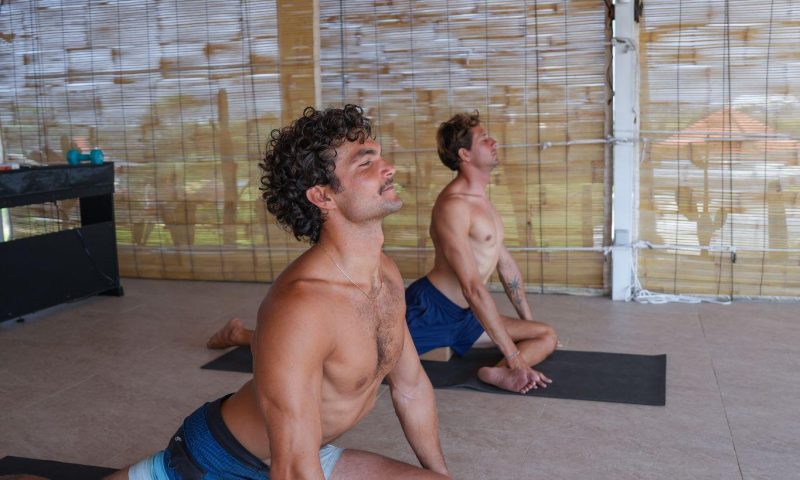
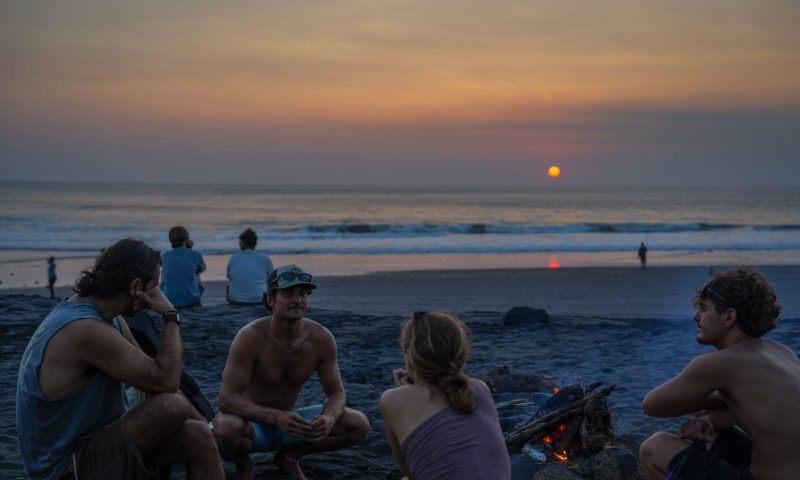
Most guests start feeling better after just a few mornings in Bali because a handful of ordinary changes stack up: earlier daylight exposure, more time outdoors, physical tiredness from surfing instead of screen fatigue, and breakfasts eaten sitting down with other people rather than beside a laptop. Mornings at a surf camp Bali — like Kavo Maison, surrounded by rice fields between Canggu and Kedungu, move at an unhurried pace, from surf lessons Canggu and the west coast to long, community-centred breakfasts and post-surf yoga, with session times shaped by the day’s swell and tide rather than a fixed schedule. Nothing dramatic happens, but by day three the day simply begins from a different place. Read on to see why Bali mornings are often what guests remember most, or explore our surf and yoga retreat Bali packages to experience the rhythm yourself.
Ask someone what they remember most about a week in Bali and they might tell you about a surf session, a temple or a sunset.
Ask them what actually felt different, though, and the answer is often much less dramatic.
The mornings.
Somewhere around day two or three, something starts to shift.
You wake up earlier, sometimes before the alarm. The light is already coming through the room. Someone is moving around outside. Maybe you hear birds, maybe a scooter in the distance, maybe the first people getting ready to surf.
And, strangely, getting out of bed doesn’t feel like such a negotiation.
It isn’t because you’ve suddenly become one of those people with a perfect morning routine.
Quite the opposite.
For a few days, you’ve probably stopped trying so hard to have one.
You’re outside more. You’re moving. You’re getting tired from surfing, swimming, walking and being in the sun instead of from staring at a screen until midnight.
You go to bed differently.
So you start waking up differently too.
Nothing revolutionary happened.
But the day begins from a completely different place.
Bali mornings start earlier than you expect
The first thing many visitors notice is the light.
Bali sits close to the equator, so sunrise and sunset happen relatively early throughout the year. You don’t have those very long European summer evenings where the sun hangs around until nine or ten.
Morning arrives quickly.
And life seems to arrive with it.
By the time you’re properly awake, offerings are being placed outside homes and businesses, warungs are opening and people are already on the road.
If you’re staying somewhere surrounded by rice fields, the morning has its own soundtrack.
It’s not silent, exactly.
Bali rarely is.
Roosters seem to have fairly strong opinions about sunrise.
But there’s a softness to those first hours that disappears once the heat, traffic and general movement of the day pick up.
After a couple of mornings, waking up early stops feeling like something you should do because it’s “healthy.”
You just don’t really want to miss that part of the day.
Then there’s the ocean
For surfers, the morning often revolves around conditions rather than a clock.
There isn’t one rule saying you should always surf at sunrise. Tide, swell, wind and the surf spot all matter, which is why local knowledge is important.
But when the conditions line up for an early session, there’s something very good about being in the water before the rest of the day has properly started.
Your phone isn’t there.
There are no emails in the ocean.
Nobody can ask you to quickly do something while you’re paddling for a wave.
For an hour or two, your attention gets reduced to something extremely basic.
Paddle.
Look up.
Wave coming.
Go.
For someone taking their first surf lessons Canggu or around Bali’s west coast, that concentration can be surprising.
You don’t have much room to think about work when you’re trying to remember where your feet are supposed to land.
Maybe that’s part of why people come back from the water looking so awake.
Surfing before breakfast hits differently
There’s hungry, and then there’s I’ve been paddling around in the ocean all morning hungry.
Breakfast after surfing becomes an event.
Fresh fruit. Eggs. Coffee. Something sweet if you’re lucky. More coffee.
But the food isn’t the only difference.
It’s the fact that you’re sitting down for it.
At home, breakfast is often whatever can be fitted between waking up and leaving. Coffee gets drunk while getting dressed, walking somewhere or opening a laptop.
Here, nobody really needs you to finish it in seven minutes.
So breakfast stretches.
Someone starts talking about the morning’s surf. Somebody else is laughing about their wipeout. Plans for the afternoon slowly appear, disappear and change again.
At a surf camp in Bali, the breakfast table is often where the social side of the camp actually happens.
You can organise as many community activities as you like.
Sometimes all people really needed was a table and enough time to stay at it.
Coffee tastes better when it isn’t transportation
This probably doesn’t deserve its own section.
But it does.
There is an enormous difference between drinking coffee because you need caffeine on the way to something and drinking coffee because you’re sitting somewhere nice and would like another coffee.
Same drink.
Completely different experience.
It’s such a small thing that people don’t really notice it happening.
Then, after a few days, you’re sitting there at 9:30 with an empty cup, talking to somebody you didn’t know three days ago, and you realise you haven’t looked at the time for an hour.
That’s the kind of luxury that’s difficult to put in a retreat brochure.

What does yoga add to a Bali morning routine?
Not everybody wakes up desperate to do a sixty-minute yoga flow.
They shouldn’t have to.
Sometimes ten minutes of stretching feels considerably more useful.
Surfing asks a lot from the shoulders, upper back, hips and core, particularly when you’re a beginner and every movement still requires more effort than it probably should.
Stretching after a session can simply feel good.
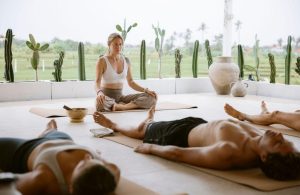
That’s one reason surfing and yoga sit so naturally together. A surf and yoga retreat Bali doesn’t have to be about becoming an advanced surfer and yogi simultaneously.
For most people, it isn’t.
One activity is dynamic and unpredictable. The other gives you a chance to slow things down, breathe and notice what your body is doing.
Some mornings you’ll want the whole class.
Another morning, your body might vote for coffee.
We respect democracy.
Not every morning needs to be productive
This might be the nicest part.
There’s a whole industry built around morning routines.
Wake up at five.
Cold shower.
Journal.
Meditate.
Exercise.
Read ten pages.
Write down three things you’re grateful for.
And somehow complete all of this before the sun has properly come up.
If that works for you, wonderful.
But you don’t need to turn Bali into another self-improvement project.
A good morning can be surprisingly ordinary.
Wake up.
Open the door.
Drink some water.
Go surfing.
Eat breakfast.
Sit around longer than necessary.
That’s enough.
A wellness retreat in Bali doesn’t need to make you feel as though you’re failing wellness because you skipped meditation one morning.
Sometimes feeling better comes from having fewer things you’re supposed to accomplish.
Canggu wakes up quickly, which is why location matters
Canggu is not particularly interested in remaining quiet all morning.
Once the day gets moving, it gets moving.
Scooters, cafés, gyms, construction, deliveries, people heading to the beach. Central Canggu has an energy that many travellers love, but it isn’t necessarily where you go looking for stillness.
Move away from the centre and the morning feels different.
This has become even more interesting as Kedungu has started attracting travellers and surfers who want to explore further along Bali’s west coast.
The areas between Canggu and Kedungu give you a useful middle ground.
You can access Canggu’s cafés, restaurants and social scene without needing to wake up inside it. Kedungu is close enough to explore as well, whether you’re interested in the growing food scene, the coastline or Kedungu surf.
Kavo Maison sits roughly halfway between the two, around ten minutes from Canggu and ten minutes from Kedungu.
For us, that’s become one of the nicest things about the location.
You wake up among rice fields.
The busy stuff can wait.
Some mornings head towards Canggu, others towards Kedungu
Surfing makes this location even more useful.
You don’t choose a surf spot because it’s the one closest to your breakfast table.
Conditions change.
A good instructor looks at the swell, wind, tide and the ability of the surfers before deciding where a session makes sense.
That flexibility matters, particularly for beginners.
Being positioned between Canggu and Kedungu gives us access to different parts of Bali’s west coast rather than building the entire experience around one beach.
For someone searching for a surf camp near Canggu but interested in seeing something beyond the usual Canggu bubble, it’s a good balance.
You don’t really need to choose one or the other.

Why do you start waking up naturally after a few days?
There probably isn’t one romantic Bali explanation for it.
You’re spending more time outside.
You’re exposed to natural daylight earlier.
You’re moving your body.
You may be drinking less alcohol than on a typical party holiday.
You’re physically tired after surfing.
And, hopefully, you’re not answering work messages at one in the morning.
Put those fairly ordinary things together and your daily rhythm can begin to feel different.
The important part is that nobody needs to force it.
You don’t have to arrive at a Bali surf camp and announce that you’re now a morning person.
Give it a few days.
See what happens.
The phone starts becoming slightly less important
Not irrelevant.
Let’s not get carried away.
People still take photos. They message home. They post stories. They check what everyone wants to do later.
But mornings have a way of creating little gaps where the phone isn’t the first thing happening.
Especially when there’s a surf session.
You’re getting ready.
Eating something.
Talking to people.
Heading towards the ocean.
For a while, there isn’t much reason to scroll.
And if you’ve been living in a routine where your phone is the first thing you see every morning, that alone can feel surprisingly different.
No dramatic digital detox in Bali required.
Just an hour when something else gets your attention first.
By day three, nothing huge has changed
This is the strange part.
You’ve been in Bali for three days.
You haven’t reinvented yourself.
You haven’t solved your life.
You probably still have hundreds of unread emails waiting somewhere.
And yet you might feel better.
Maybe you slept properly.
Maybe your shoulders hurt from surfing, but it’s the satisfying kind of tired.
You’ve eaten breakfast sitting down three days in a row.
You’ve been outside before nine in the morning.
You’ve talked to people before looking at a screen.
Small things.
Stacked together, they begin to feel less small.

And then you take the routine home, or at least part of it
Nobody needs to return from Bali and recreate the entire thing.
Most of us don’t have a surf break outside the front door.
There may not be a rice field outside the kitchen either.
But perhaps that’s not the part worth taking home.
Maybe it’s eating breakfast without a laptop once in a while.
Going outside before work.
Moving in the morning because it feels good.
Leaving the phone alone for twenty minutes after waking up.
Having coffee sitting down.
It would be nice if every healthy habit required moving to Bali.
Unfortunately, most of them are considerably less exciting.
Maybe that’s why mornings are what people remember
The obvious things are easy to photograph.
The wave.
The yoga pose.
The smoothie bowl.
The sunrise.
What’s harder to photograph is the feeling underneath all of it.
Waking up and not immediately feeling behind.
Having nowhere urgent to be.
Being physically tired instead of mentally exhausted.
Eating breakfast with people instead of beside a screen.
That’s often what guests mean when they tell us they feel different after a few days.
Not transformed.
Just a little more like themselves again.
At Kavo Maison Surf & Yoga Camp, mornings aren’t designed around some perfect wellness formula. We’re surrounded by rice fields, roughly ten minutes from both Canggu and Kedungu, and the rhythm of the day usually starts with movement, breakfast and people coming together.
There are surf sessions, yoga, coffee and whatever the rest of Bali decides to add that morning.
Then the day can figure itself out from there.

FAQ
What does a typical morning at a surf camp in Bali look like?
It depends on the surf conditions and the camp. At a surf camp Bali, mornings may include an early surf session, breakfast, yoga or free time. Surf schedules should remain flexible because tides, wind and swell can change when and where it makes sense to surf.
Is morning the best time to surf in Bali?
Morning can offer good surf conditions on many days, but it isn’t automatically the best time everywhere. The ideal time depends on the surf spot, tide, wind, swell and your ability. Local instructors should assess the conditions rather than relying on a fixed morning schedule.
Can complete beginners take surf lessons around Canggu?
Yes. Surf lessons in Canggu are popular with beginners, although the appropriate location changes according to conditions. Complete beginners should surf with experienced instructors who can choose a suitable spot and provide the right equipment.
Is Kedungu good for surfing?
Kedungu is known for surfing and is attracting increasing interest from surfers and travellers exploring Bali’s west coast. Conditions and suitability vary, so beginners shouldn’t assume that every Kedungu surf spot is appropriate for their level on any given day.
Where should I stay if I want to explore both Canggu and Kedungu?
Staying between Canggu and Kedungu gives you convenient access to both without needing to base yourself in central Canggu. Kavo Maison is positioned roughly halfway between them, around ten minutes from either area.
Is yoga useful after surfing?
Yoga and gentle mobility work can complement surfing because paddling and pop ups use the shoulders, back, hips and core repeatedly. This is one reason surf and yoga retreats Bali are a popular combination, although recovery and rest are just as important.
Do I need to be a morning person to join a Bali surf camp?
No. Surf times depend partly on ocean conditions, so some sessions may start earlier than others. Most people find that their routine naturally adjusts after a few days of spending more time outdoors and being physically active.